
Table of Contents
- ADAS Calibration vs Wheel Alignment: What’s the Difference?
- Side-by-Side Comparison: ADAS Calibration and Wheel Alignment
- How Wheel Alignment Affects ADAS Sensor Accuracy
- Signs Your ADAS Needs Calibration
- How Long Does ADAS Calibration Take?
- Is ADAS Calibration Covered by Insurance?
- DIY vs Professional ADAS Calibration: Equipment and Safety
- Conclusion
- Frequently Asked Questions
Last Updated: October 2, 2026
ADAS Calibration vs Wheel Alignment: What’s the Difference?
ADAS calibration is the process of realigning a vehicle’s advanced driver assistance system sensors, such as cameras and radar, to the manufacturer’s specifications after a windshield replacement or collision repair. Wheel alignment adjusts the suspension angles that determine how the tires meet the road. They are two separate services, performed with different equipment, and one does not replace the other.
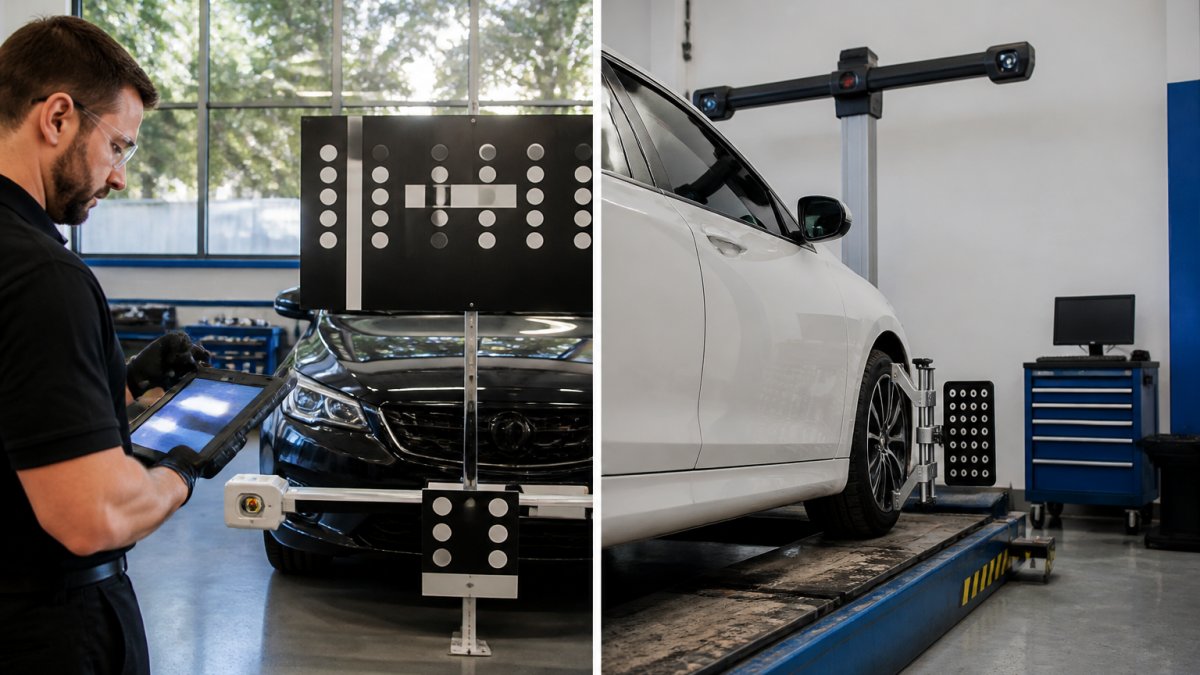
This distinction matters more than most drivers realize. Modern vehicles rely on a sensor array mounted behind the windshield, in the grille, and around the bumpers.
Here is the core issue: wheel alignment works on the chassis, while ADAS calibration works on the electronics. A shop can align your wheels perfectly and still leave a forward-facing camera pointing at the wrong patch of road.
Wheel alignment corrects how the vehicle sits on the road. ADAS calibration corrects how the vehicle’s sensors see the road. You need both, but they solve different problems.
Side-by-Side Comparison: ADAS Calibration and Wheel Alignment
The clearest way to understand these two services is to compare them directly across the criteria that actually affect your decision: what they adjust, what triggers them, and who can perform them.
| Factor | ADAS Calibration | Wheel Alignment |
|---|---|---|
| What it adjusts | Camera, radar, and lidar sensor angles | Suspension geometry and tire angles |
| Reference frame | Vehicle centerline and thrust line | Vehicle centerline and thrust line |
| Triggered by | Windshield replacement, collision, sensor fault, ride height change | Tire wear, pulling, curb impact, suspension repair |
| Equipment | Calibration targets, diagnostic software, level floor | Alignment rack, camber and toe gauges |
| Typical provider | Auto glass or collision shop | Alignment or tire shop |
| Time required | Varies by vehicle and method | Roughly an hour |
| DIY possible | No, requires OEM protocols | No, requires a rack |
| Order in workflow | After geometry is confirmed | Before calibration |
The table makes one thing obvious: these services live in different worlds. A wheel alignment rack cannot recalibrate a camera, and a calibration target cannot fix a bent tie rod.
The Sensor-to-Suspension Dependency Chain
What most guides miss is the technical chain that links the two services. It runs in one direction, and skipping a link breaks the whole result:
- Suspension geometry sets the thrust line, the direction the rear axle pushes the vehicle.
- Thrust line defines the vehicle’s true centerline as it travels down the road.
- Sensor mounting points (windshield bracket, grille, bumper) are fixed to the body, not the wheels.
- Calibration software assumes the body is square to the thrust line when it aims the sensors.
- If the thrust line is off, the sensors are aimed relative to a skewed reference, and the calibration is wrong even though the software reports success.
This is why the order of operations matters. If your suspension is out of spec, calibrating the sensors first is wasted effort, because the vehicle’s thrust line will shift the moment the alignment changes. Get the geometry right, then calibrate.
Diagnostic Workflow Differences
The two services also diverge in how a technician diagnoses a problem. A wheel alignment starts with a road test and a rack reading: camber, caster, toe, and thrust angle. An ADAS calibration starts with a scan tool: diagnostic trouble codes, sensor health checks, and a verification that ride height and tire pressure are within OEM spec. A shop that treats calibration as a plug-in procedure skips the scan, and that is how a misaligned suspension quietly corrupts a fresh calibration.
Alignment and calibration share one reference frame, the thrust line. Alignment sets it; calibration depends on it. Do them in that order, every time.
How Wheel Alignment Affects ADAS Sensor Accuracy
Wheel alignment affects ADAS accuracy because the sensors are calibrated against a reference frame that assumes the vehicle is square and level. When suspension geometry is off, the vehicle travels at a slight angle relative to its own centerline. A forward-facing camera pointed straight ahead then reads a road that is drifting sideways.
Think about lane departure warning and lane keeping assist. These systems compare the camera’s view of lane markings against the steering angle. If the car is crabbing down the road, the camera sees the lane at an offset, and the system may either fail to warn or warn when nothing is wrong.
- Active cruise control relies on radar aimed at a specific point ahead. Misalignment tilts that aim.
- Collision avoidance depends on the same forward reference. A small error grows with distance.
- The steering angle sensor must agree with the camera. A misaligned suspension creates disagreement.
This is the overlap between the two services. Alignment is not a substitute for calibration, but poor alignment quietly degrades a calibration that was done correctly. That is why post-repair verification should include a check of both.
Signs Your ADAS Needs Calibration
The most reliable sign your ADAS needs calibration is a dashboard warning light for a safety system, often paired with a diagnostic trouble code stored in the electronic control unit. Other signs are behavioral: the lane warning chimes for no reason, or the system stops working entirely.
Watch for these indicators:
- A lane departure or collision warning light that stays on
- The system disengages without input on a clear road
- A recent windshield replacement or collision repair
- Rotated tires, a suspension repair, or a changed ride height
- Warning messages that appear only at highway speed
Sensor drift is the quiet culprit. Cameras and radar units can lose their reference over time from vibration, temperature swings, and minor impacts. A system that worked last year may be subtly off today. According to National Highway Traffic Safety Administration guidance on driver assistance systems, these systems are designed to assist, not replace, an attentive driver, which is exactly why keeping them accurate matters.
If you see any of these signs, do not wait. A miscalibrated collision avoidance system gives you a false sense of security.
Ignoring a persistent ADAS warning light does not just disable a convenience feature. A camera that is out of calibration can cause lane keeping assist to steer against you, which turns a safety aid into a hazard.
How Long Does ADAS Calibration Take?
ADAS calibration typically takes between 30 minutes and several hours, depending on the vehicle, the number of sensors involved, and whether the shop uses static or dynamic methods. The service itself is not long, but the preparation and verification add time.
Two methods dominate the work:
- Static calibration uses physical targets placed at exact distances and angles around the vehicle. The car stays put while the system reads the targets. This method is precise but requires dedicated floor space and setup time.
- Dynamic calibration requires driving the vehicle at specific speeds on clear, well-marked roads so the system can relearn its reference. Weather and traffic can delay it.
Most of the time is spent on setup, not the calibration itself. Positioning calibration targets to OEM specifications, leveling the floor, and confirming the vehicle’s ride height all happen before the system is touched. Then the technician runs the calibration software and verifies the result.
For a fleet, this timing matters. A vehicle that is out of service for half a day affects routes and schedules.
Is ADAS Calibration Covered by Insurance?
ADAS calibration is often covered by insurance when it is required as part of a covered repair, such as a windshield replacement or collision claim.
Here is the practical reality. Many insurers now treat recalibration as a necessary part of a safe repair, because the manufacturer requires it after certain work. Others may require documentation showing that calibration was specified by the vehicle maker.
Are Alignment and Calibration Separate Claims?
This is the question most guides skip, and it is the one that decides whether you pay out of pocket. In practice, insurers tend to treat the two services differently:
- Calibration is usually bundled into the covered repair when it is a documented OEM requirement, for example, after a windshield replacement on a vehicle with a forward-facing camera. It appears as a line item on the same claim.
- Alignment is more often classified as maintenance unless it is tied to a covered collision or suspension repair. A standalone alignment after normal tire wear is typically the owner’s responsibility.
- When both follow one event, a collision that bent a control arm and cracked a windshield, a single claim can cover both, but the shop must document the causal link between the impact and each service.
The friction point is the gap between “repair” and “maintenance.” If your sensors drift and you want a calibration with no triggering event, that is usually on you. If the calibration follows a covered windshield replacement, it is far more likely to be included. If an alignment is needed to make that calibration valid, some adjusters will approve it as a prerequisite; others will not, and that is where a written OEM procedure earns its keep.
What to Ask Before the Work Starts
Call your insurer and ask two specific questions: “Is recalibration included when my windshield is replaced?” and “If an alignment is required before calibration, is that covered on the same claim?” Get the answers before the work starts, not after.
Ask the shop to document the calibration with before-and-after readings, the OEM procedure used, and, if an alignment was required, the pre- and post-alignment thrust angle. Insurers are far more likely to pay a claim that arrives with that paperwork attached than one that simply lists “calibration” as a line item.
DIY vs Professional ADAS Calibration: Equipment and Safety
Professional ADAS calibration is not a DIY job. The equipment alone, from calibration targets to diagnostic software, costs more than most drivers would ever spend, and the procedures are vehicle-specific and unforgiving. A shop uses systems like the Autel IA1000 ADAS calibration system, which supports both static and dynamic procedures and integrates with diagnostic tablets for real-time sensor data.
Compare that to what a home setup would require:
- OEM-specific targets for your exact make and model
- A level floor with the correct clearance in every direction
- Diagnostic software that reads and clears sensor codes
- Manufacturer protocols that change by model year
The safety stakes are the real argument. ADAS components are safety-critical components. A camera calibrated a few degrees off does not throw an error; it simply performs worse, and you may not notice until you need it.
There is also a diagnostic workflow difference that separates a professional job from a guess.
This is where credentials matter. AGSC, NGA, I-CAR, and Delta certifications exist precisely because this work has a right way and many wrong ways.
Conclusion
The gap between a properly calibrated vehicle and one that merely had its wheels straightened is invisible until the moment it counts. If your windshield has been replaced, your suspension has been worked on, or a warning light has appeared, you need a shop that understands both sides of this equation.
Area Wide Auto Glass brings more than 30 years of experience to that work, with certified technicians trained in ADAS calibration, OEM-quality glass, and a lifetime warranty on materials and labor.
Frequently Asked Questions
Is ADAS calibration necessary?
Yes. ADAS calibration is necessary whenever a windshield is replaced, the vehicle’s ride height changes, or a wheel alignment is performed. Without recalibration, sensors like cameras and radar can be misaligned, causing lane departure warning or automatic emergency braking to fail. Most vehicle manufacturers require calibration after any event that alters sensor position. Area Wide Auto Glass technicians are trained to perform this service to factory specifications.
What is the difference between ADAS calibration and wheel alignment?
Wheel alignment adjusts the angles of the wheels and suspension to the vehicle’s thrust line, ensuring it tracks straight. ADAS calibration aims the cameras and radar sensors that power advanced driver assistance systems. While they are separate services, they are linked: a misaligned wheel can change the vehicle’s thrust line and throw off sensor aim. That is why many shops recommend checking alignment before or after ADAS calibration.
Does a wheel alignment affect ADAS sensors?
Yes. Wheel alignment directly affects ADAS sensors because it changes the vehicle’s thrust line, which is the direction the rear wheels point relative to the front. If the thrust line is off, the forward-facing camera and radar may be aimed incorrectly, leading to false lane departure warnings or missed collision avoidance alerts. After a significant alignment adjustment, ADAS recalibration is often required to restore sensor precision.
Can I do ADAS calibration myself?
Performing ADAS calibration yourself is not recommended. It requires OEM-specific targets, a level floor, precise distance measurements, and calibration software that communicates with the vehicle’s electronic control unit. Without the right equipment and training, you risk leaving safety-critical systems misaligned. Professional shops like Area Wide Auto Glass have the certified technicians and tools to complete the job correctly.
Is ADAS calibration covered by insurance?
In many cases, yes. If your insurance policy covers windshield replacement, it often includes ADAS recalibration as part of the claim because it is required to restore the vehicle to pre-loss condition. Coverage depends on your specific policy and deductible. Area Wide Auto Glass offers direct billing with all major insurance companies, which can minimize your out-of-pocket costs.

