
Table of Contents
- What Is the ADAS Windshield Recalibration Process?
- How Cameras and Sensors Use Your Windshield
- Why Calibration Restores Accuracy
- Is ADAS Calibration Necessary After Windshield Replacement?
- Static vs Dynamic ADAS Calibration: What’s the Difference?
- Step-by-Step: How the Recalibration Process Works
- How Long Does Windshield Calibration Take?
- Troubleshooting Failed Calibrations and Common Mistakes
- Insurance, DIY Risks, and Vehicle-Specific Requirements
- Conclusion
- Frequently Asked Questions
Last Updated: September 19, 2026
What Is the ADAS Windshield Recalibration Process?
The ADAS windshield recalibration process realigns a vehicle’s forward-facing camera and radar sensors after a windshield replacement so driver assistance systems read the road correctly. Skip it and lane keep assist may drift or automatic emergency braking may fire late.
How Cameras and Sensors Use Your Windshield
Your windshield holds the hardware that watches the road: a camera cluster behind the rearview mirror aimed through a specific zone of the glass, plus radar units behind the bumper or near the mirror.
These sensors feed data to systems like:
- Lane departure warning and lane keep assist
- Automatic emergency braking
- Adaptive cruise control
- Forward collision alerts
Why Calibration Restores Accuracy
Calibration restores the alignment between what the camera sees and where the vehicle sits on the road. Think of zeroing a scope: the sensor works fine, but its aim is off until you reset the reference point.
A new windshield can be installed perfectly and still leave your safety systems misaligned. Calibration is what closes that gap.
Is ADAS Calibration Necessary After Windshield Replacement?
Yes, calibration is necessary after windshield replacement on any vehicle with a camera or radar mounted to the glass. The replacement changes the geometry the sensor relies on, even when the new glass matches the old part exactly.
What Happens If You Skip Calibration
Skipping calibration leaves your driver assistance features running on bad data. You may not notice at first, because the systems still turn on. The failure is quiet.
Watch for these outcomes:
- Lane keep assist pulls toward the wrong side
- Forward collision warnings trigger late or not at all
- Adaptive cruise control hesitates or surges
- Dashboard warning lights stay on
Static vs Dynamic ADAS Calibration: What’s the Difference?
Static and dynamic calibration are the two methods used to realign ADAS sensors, and the automaker, not shop preference, sets the right one. The difference is what the sensor uses as its reference point.
| Method | Reference Source | Where It Happens | Key Requirement | Typical Sensor Types |
|---|---|---|---|---|
| Static | Fixed target boards | Shop bay | Level floor, OEM targets, factory scan tool | Forward camera, lidar, surround-view |
| Dynamic | Real road features | Public road | Defined speed, clear markings, good light | Corner radar, some forward radar |
| Hybrid | Targets, then road | Bay plus road | Both of the above, in sequence | Vehicles needing alignment plus confirmation |
Why Automakers Pick One Method Over the Other
- Cameras need a fixed reference. A forward camera behind the rearview mirror is bolted to the windshield and body, so its aim is a geometry problem best solved against a known target. Camera-based systems lean static.
- Radar can self-learn. Radar measures distance and relative speed, not images, so a corner radar can build its reference from driving by establishing a baseline from consistent returns. Radar-based systems often lean dynamic.
- Some vehicles need both. A model with a forward camera and corner radar may need a static alignment for the camera, then a dynamic drive to confirm the radar. Skipping either step leaves one sensor on a false baseline.
What the Technician Actually Does
In a static job, the sequence is unforgiving. The bay floor must be flat within tight tolerances, and target boards go at OEM-specified distances, often measured to the millimeter. Tire pressures and fuel level are set because both change ride height, which changes camera angle. The scan tool then walks the technician through the sequence as the camera reads each target.
The method is not a shop’s choice. It is written into the vehicle’s service information, and using the wrong method leaves the system on a false baseline even if the dashboard light goes off.
Which Method Your Vehicle Needs
Your vehicle’s service information decides the method: some automakers require static only, others dynamic only, and a growing number need both, a static alignment followed by a road test to confirm.
Step-by-Step: How the Recalibration Process Works
Recalibration follows a set sequence, each step protecting the next.
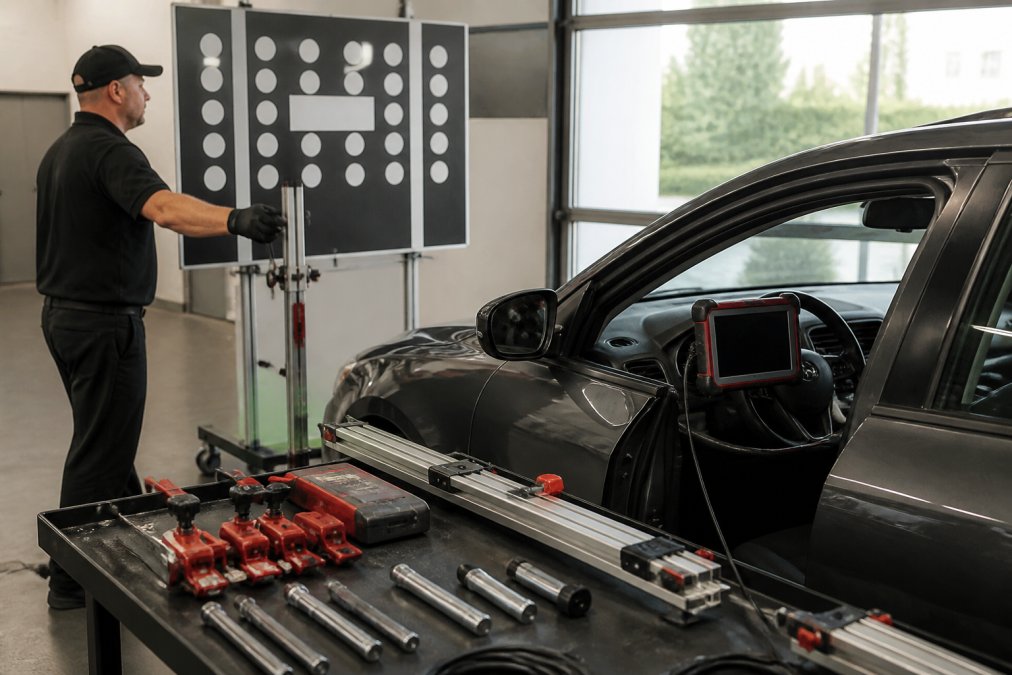
Pre-Calibration Checks and Vehicle Preparation
- Scan for codes. The technician runs a diagnostic scan tool to check for existing faults.
- Check tire pressure and fuel level. Both affect ride height, which affects camera angle.
- Confirm a level surface. The bay floor must be flat within tight tolerances.
- Set target distances. Target boards go at the exact spacing the automaker specifies.
- Clear the camera view. Dirt, stickers, or tint in the camera zone will skew results.
Running the Calibration and Post-Repair Verification
- Start the calibration software. The scan tool guides the sequence step by step.
- Let the system read the targets. The camera locks onto each board in turn.
- Complete the road test if required. The technician drives the set route at the set speed.
- Clear and re-scan codes. Any remaining fault means the job is not done.
- Verify with a post-repair check. Confirm the systems power on and read correctly.
Never accept a “calibration included” promise without a post-repair scan. If the shop hands back the keys without clearing codes, you have no proof the system reset.
How Long Does Windshield Calibration Take?
Windshield calibration usually adds 30 to 60 minutes to a replacement, though some vehicles take longer. Static jobs run faster once targets are set; dynamic jobs depend on traffic and weather.
Plan for these time blocks:
- Glass replacement: 60 to 90 minutes
- Static calibration: 30 to 45 minutes
- Dynamic calibration: 30 to 60 minutes
- Hybrid jobs: 60 to 90 minutes
Troubleshooting Failed Calibrations and Common Mistakes
Failed calibrations usually trace back to preparation, not equipment. The scan tool reports a fault, and the technician finds the cause before retrying.
The usual culprits:
- Low tire pressure. Ride height drops and the camera angle shifts.
- A dirty or damaged camera. A scratched lens will not read targets clean.
- Wrong target spacing. Even a few centimeters off can fail the sequence.
- Aftermarket glass out of spec. Cheap glass can sit at the wrong angle.
- Traffic during a road test. The system needs steady conditions to learn.
Insurance, DIY Risks, and Vehicle-Specific Requirements
This is where most guides stop short and the real-world decisions live: who pays, who may touch the car, and what your specific vehicle requires.
How Insurance Handles Calibration
Whether calibration is covered usually comes down to how the claim is filed, not whether the policy mentions “calibration.”
- Comprehensive claims (glass damage). When a windshield is replaced under comprehensive coverage, most insurers treat recalibration as part of the covered repair because the safety system cannot function without it. Some states require insurers to cover it when glass is covered.
- Collision claims. If the windshield broke in a crash, calibration typically falls under the collision repair estimate. Ask the adjuster to add it as a line item before approving the supplement.
- Liability-only policies. If you carry only the state minimum, glass and calibration are usually out of pocket.
- Glass coverage endorsements. Some policies add a glass endorsement with a lower or zero deductible. Confirm whether calibration is inside that endorsement or billed against the main deductible.
Before you authorize the work, ask three questions: Is calibration billed as part of the glass claim or separately? Will the shop submit the OEM procedure documentation? What is my out-of-pocket if the insurer denies it?
Why DIY Calibration Fails
DIY is not a matter of skill but of access. The failure modes are structural:
- No factory software. The relearn sequence needs a scan tool loaded with the automaker’s calibration routine. Generic OBD-II readers cannot start it.
- No target set. Static calibration requires OEM-specific target boards at OEM-specified distances and heights. A printed paper target at the wrong scale will not pass.
- No level reference. The bay floor must be flat within tight tolerances. A driveway slopes.
- No controlled road test. Dynamic calibration requires specific speeds, lane markings, and lighting. Public traffic makes that unpredictable.
- No verification. Without a post-calibration scan, you cannot confirm the system reset. The dashboard light going off is not proof.
Vehicle-Specific Sensor and Calibration Requirements
Calibration method is set by the automaker and varies by sensor type and mounting position:
| Sensor Type | Typical Mount | Common Calibration Method | Why |
|---|---|---|---|
| Forward camera | Behind rearview mirror, through windshield | Static (targets) | Fixed geometry; needs a known reference |
| Forward radar | Behind bumper or grille | Static or dynamic | Depends on whether the module self-learns |
| Corner radar | Rear quarter panels | Dynamic | Learns from driving reference points |
| Lidar (limited models) | Roof or grille | Static | Requires precise target alignment |
| Surround-view cameras | Mirrors, grille, tailgate | Static | Multiple cameras stitched into one image |
A windshield you install yourself may seal perfectly and still leave your safety features blind. The seal and the calibration are two separate jobs, and only one of them is visible.
Conclusion
ADAS calibration keeps your safety systems honest after a windshield swap; skipping it leaves features that look active but read the road wrong. Area Wide Auto Glass brings certified technicians and ADAS calibration training to your home or workplace, with same-day service, OEM-quality materials, and a lifetime warranty on materials and labor. We also bill your insurance directly to keep your out-of-pocket cost down.
Frequently Asked Questions
Does replacing a windshield require ADAS calibration?
Yes, in most modern vehicles. When a windshield is replaced, the forward-facing camera mounted behind the glass is removed and reinstalled. Even a tiny shift in camera angle can throw off lane departure warning, adaptive cruise control, and autonomous emergency braking. Most vehicle manufacturer specifications require recalibration after any windshield replacement on a car equipped with advanced driver assistance systems.
How long does ADAS recalibration take?
Static calibration typically takes 30 to 60 minutes once the vehicle is in position, though some automakers require longer. Dynamic calibration adds a road test of 10 to 30 minutes at specific speeds. The full appointment, including setup, pre-checks, and post-repair verification, often runs one to two hours depending on the vehicle and the calibration method required.
Is static or dynamic calibration better for my vehicle?
Neither is universally better. Static calibration uses target boards in a controlled bay and suits vehicles that need precise camera alignment at a standstill. Dynamic calibration relies on a road test and works for systems that learn while driving. Your vehicle manufacturer specifications dictate which method applies. Some vehicles require both, and technicians follow OEM standards rather than choosing freely.
What happens if you don’t calibrate your ADAS after windshield replacement?
Uncalibrated sensors can misread lanes, brake late, or fail to detect obstacles. Lane keep assist may pull the wheel when it shouldn’t, and autonomous emergency braking could trigger late or not at all. The system may also throw dashboard warning lights. Beyond safety, skipping calibration can void portions of your insurance coverage if a claim involves a driver assistance failure.
