
Table of Contents
- Why Dealership Windshield Replacement Isn’t Your Only Option
- OEM vs Aftermarket Windshield Quality: What Modern Cars Actually Need
- ADAS Windshield Calibration Requirements for Independent Shops
- Mobile Windshield Replacement Benefits for Busy Owners and Fleets
- Cost Comparison: Dealership vs Independent Windshield Replacement
- Warranty, Lease Return, and Post-Installation Inspection Checklist
- Frequently Asked Questions
Last Updated: September 30, 2026
Why Dealership Windshield Replacement Isn’t Your Only Option
Dealership windshield replacement is just one path, and for most modern cars it is not the fastest or most convenient one. Independent auto glass shops handle the same OEM glass, the same camera recalibration, and the same insurance billing, often at your home or office instead of a service lane.
This guide from Area Wide Auto Glass covers the full range of windshield replacement alternatives for modern cars, from mobile independent shops to OEM-grade glass sourcing and DIY chip repair. We have handled glass on sensor-equipped vehicles since long before cameras became standard, so we know where the dealer-only myth comes from and where it falls apart.
Here is the core tension: modern windshields are no longer just glass. They are structural and optical components of your vehicle’s safety systems. That raises a fair question. If the glass is that important, shouldn’t the dealer do it?
Not necessarily. What matters is not who owns the building. It is whether the shop uses OEM-grade glass, follows factory specifications, and recalibrates the cameras afterward. Plenty of independent shops do all three. Below, we break down quality, calibration, cost, and warranty so you can compare windshield replacement alternatives on evidence instead of brand loyalty.
OEM vs Aftermarket Windshield Quality: What Modern Cars Actually Need
OEM glass is manufactured to the vehicle maker’s original specifications, while aftermarket glass is produced by a third party to its own tolerances. Both can be safe. They are not identical, and the gap shows up in ways that matter on modern cars.
Original equipment manufacturer (OEM) glass matches factory glass thickness, curvature, and optical clarity. On vehicles with a heads-up display, an acoustic interlayer, or embedded rain sensors, that match is not cosmetic. The wrong curvature or coating can distort a projected image or confuse a sensor.
Aftermarket glass varies widely by manufacturer. Some aftermarket windshields meet or exceed factory specifications. Others cut corners on glass thickness or skip the acoustic interlayer, which shows up as more road noise and, in some cases, calibration trouble.
What most guides miss is that “OEM-quality” is a claim, not a certificate. Ask what you are actually getting before you book.
How to Verify Glass Grade Before Installation
Ask three questions before anyone touches your car:
- Who manufactured the glass? A reputable shop will name the manufacturer and show you the label.
- Does it carry the DOT certification mark? Windshield glass sold in the U.S. must meet federal safety standards, and the DOT number identifies the manufacturer.
- Does it match your VIN? For sensor-equipped vehicles, the glass part number should correspond to your specific trim and options.
If a shop dodges these questions, that is your answer. Walk away.
Photograph your windshield’s existing markings before installation. The small etched logo near the bottom edge tells you the original manufacturer and glass grade, which gives you a baseline to compare against whatever the shop installs.
ADAS Windshield Calibration Requirements for Independent Shops
ADAS windshield calibration requirements apply to any shop replacing glass on a vehicle with advanced driver assistance systems, dealer or not. The camera behind your windshield must be aimed and verified after installation, or systems like lane departure warning and automatic emergency braking may not work correctly.
This is the single biggest reason people assume they need the dealer. It is also the reason a careless independent shop can leave you with a windshield that looks perfect and a safety system that is quietly offline.
Calibration is the process of aligning the forward-facing camera to factory specifications after the new glass changes its position by even a fraction of a degree. Two methods exist, and your vehicle dictates which one applies.
Static vs Dynamic Calibration: What Your Vehicle Requires
Static calibration happens in a controlled bay. The shop places targets at measured distances in front of the vehicle and aims the camera at them. It requires space, specific targets, and a scan tool that matches your make.
Dynamic calibration happens on the road. The technician drives the vehicle at specified speeds on clear, well-marked roads while the system relearns its reference points.
Most vehicles require one or the other. Some require both. The manufacturer’s procedure for your specific model is the authority here, and a certified technician will follow it rather than guess.
Ask any shop one direct question: “Can you calibrate this vehicle to factory specifications, and how do you document it?” A shop that answers clearly and shows you the procedure is equipped.
Skipping calibration does not always trigger a dashboard warning light. A misaligned camera can leave lane-keeping and automatic braking degraded without any visible alert, which means you may not discover the problem until the moment you need the system.
Mobile Windshield Replacement Benefits for Busy Owners and Fleets
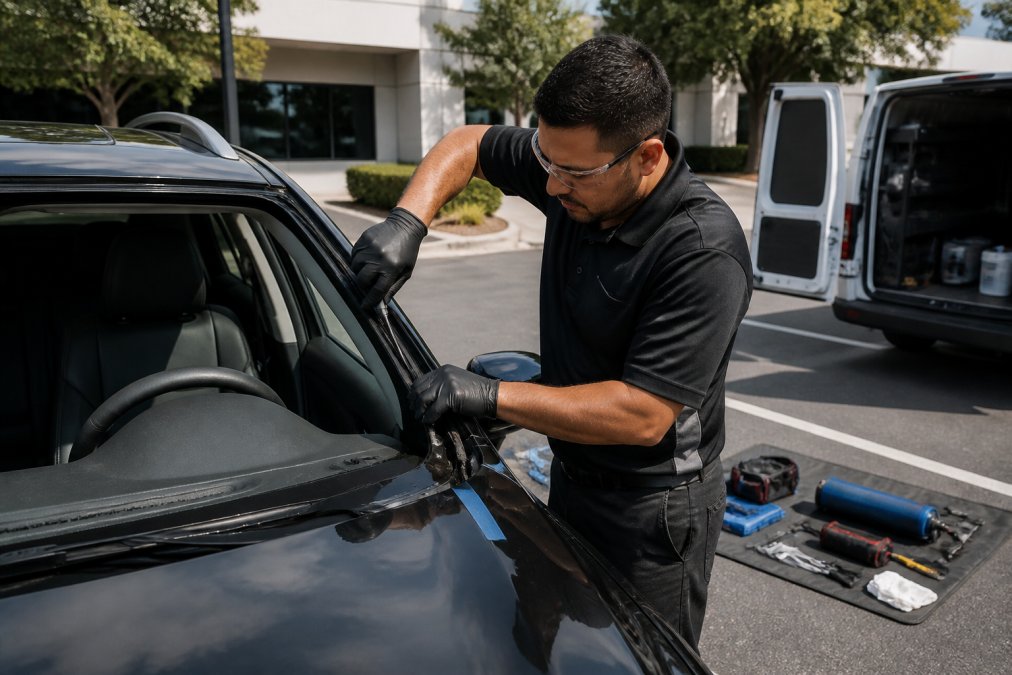
Mobile windshield replacement benefits come down to time and disruption. A technician comes to your driveway or fleet yard, completes most replacements in 30 to 90 minutes, and you never sit in a waiting room.
Cost Comparison: Dealership vs Independent Windshield Replacement
Independent shops can offer competitive pricing for the same job. The exact figures depend on your vehicle, the glass grade, and whether calibration is required, so treat any flat quote you see online with suspicion.
What drives the difference:
- Labor rates. Dealer service departments carry higher overhead per hour.
- Subcontracting. Many dealers hand glass work to a local glass company and bill you the retail rate.
- Glass sourcing. Dealers default to OEM. Independents can offer OEM or quality aftermarket, letting you choose.
- Calibration pricing. Some shops bundle recalibration into the replacement price. Others list it separately. Ask which applies.
| Factor | Dealership | Independent Shop |
|---|---|---|
| Glass options | OEM only | OEM or quality aftermarket |
| Scheduling | Service lane, by appointment | Mobile or in-shop, often same day |
| Calibration | Usually subcontracted | Often in-house and certified |
| Insurance billing | Varies by dealer | Direct billing common |
| Warranty | Manufacturer terms | Often lifetime on labor and materials |
| Typical wait | Days to weeks | Often same day |
Insurance Claim Workflow and Deductible Impact
Most windshield replacements are covered under comprehensive coverage, and many policies waive the deductible for glass repair rather than replacement. The workflow matters as much as the coverage.
Here is how a claim typically runs:
- Check your coverage. Confirm you carry comprehensive and ask whether glass repair carries a separate, lower deductible.
- File the claim. Your insurer or the glass shop can often start this for you.
- Get authorization. The insurer approves the work and the glass grade before installation.
- Schedule the work. A shop with direct billing handles the insurer paperwork so you are not fronting the full cost.
- Keep the documentation. You will want the invoice and calibration report for your records and any future claim.
The claim workflow, not the repair itself, is where most people lose time. Choosing a shop that bills your insurer directly removes the step where you pay out of pocket and wait for reimbursement.
Warranty, Lease Return, and Post-Installation Inspection Checklist
Warranty coverage and lease return requirements are the two places where a cheap installation gets expensive later. A lease return with non-compliant glass or a leaking windshield can trigger charges at turn-in, and a warranty that excludes calibration leaves you paying for it twice.
- Glass grade matches what was quoted and what your lease or insurer requires
- DOT certification mark present on the new glass
- Urethane adhesive allowed full curing time before you drive
- ADAS calibration completed and documented with a printed or digital report
- No wind noise, whistling, or water intrusion during a test drive
- Molding and trim seated flush with no gaps
- Warranty terms in writing, including whether calibration is covered
- Invoice and calibration report saved for lease return or resale
Fleet managers and busy owners who need the work done at their location, with calibration and insurance handled in one visit and a lifetime warranty on materials and labor.
Frequently Asked Questions
Which is better for windshield replacement, a dealership or an independent shop?
Independent shops that are certified in ADAS calibration can match dealership quality for modern cars. The key difference is convenience and cost: independent mobile services come to your home or office, often complete the work in 30-90 minutes, and may bill your insurance directly. Dealerships typically require an appointment and may charge more for the same OEM glass and calibration. Check that the shop holds certifications like AGSC or I-CAR before booking.
Are aftermarket windshields safe for modern cars with sensors?
Aftermarket windshields can be safe if they meet the same glass quality standards as OEM glass and are installed with proper urethane adhesive and curing time. The critical factor is ADAS calibration: cameras and sensors mounted to the windshield must be recalibrated after installation to ensure lane departure warning and automatic braking work correctly. Ask your shop whether they follow factory specifications for calibration and whether they use OEM-quality glass.
Does using an independent glass shop void my vehicle warranty?
No. Federal law (the Magnuson-Moss Warranty Act) prevents automakers from voiding your warranty simply because an independent shop performed the work. The shop must use parts that meet factory specifications and follow proper installation standards. If a defect traces back to poor workmanship or substandard glass, that specific issue may not be covered, which is why choosing a certified technician with a lifetime warranty matters.
How does ADAS calibration work with non-dealership windshield replacement?
After the new windshield is installed, the technician uses diagnostic tools to recalibrate cameras and sensors that rely on the glass for proper alignment. This can be static (in a controlled bay with targets) or dynamic (driven on a road at specific speeds). Not all independent shops have this equipment, so ask upfront whether ADAS windshield calibration requirements for your vehicle model are included in the quoted price. Skipping calibration can disable safety systems.
What is the cost difference between dealership and independent windshield replacement?
Pricing depends on your vehicle’s make, model, glass type, and whether ADAS calibration is required. Independent shops often have lower overhead and can pass savings on, especially when they bill your insurance directly and handle the claim for you. Dealerships may charge more for the same OEM glass and labor. For an accurate quote, contact Area Wide Auto Glass with your VIN and insurance details.
