
Table of Contents
- Emergency Windshield Replacement Near Me: What to Do First
- Mobile Windshield Repair and Replacement at Your Location
- How Long Does Windshield Replacement Take?
- ADAS Calibration After Windshield Replacement
- Windshield Replacement Insurance Coverage Explained
- Same-Day and 24/7 Emergency Glass Services
- What to Check Before You Book an Emergency Appointment
- Frequently Asked Questions
Last Updated: September 18, 2026
Emergency Windshield Replacement Near Me: What to Do First
A shattered windshield turns a normal drive into a safety hazard within seconds. When you search for emergency windshield replacement near me, the priority is simple: get the vehicle safe, then get a certified technician to your location. This guide from Area Wide Auto Glass walks through what to do in the first ten minutes, how mobile service works, and what to check before you book.
Safety Steps Before Help Arrives
Once stopped, follow this sequence:
- Turn on hazard lights and set the parking brake
- Avoid slamming doors, which flex the frame and can worsen a crack
- Do not touch the damaged area with bare hands; glass debris causes cuts
- Cover the opening with plastic sheeting and tape if the glass is fully gone
- Keep the damaged area out of direct sun and temperature swings until help arrives
Driving with a compromised windshield risks the glass caving inward during a crash. The windshield is a structural component, not just a window, so a vehicle with severe damage should not be driven until a technician inspects it.
Many insurance policies include roadside assistance that can tow a vehicle with a failed windshield. Check your policy documents before assuming you have to drive it.
Mobile Windshield Repair and Replacement at Your Location
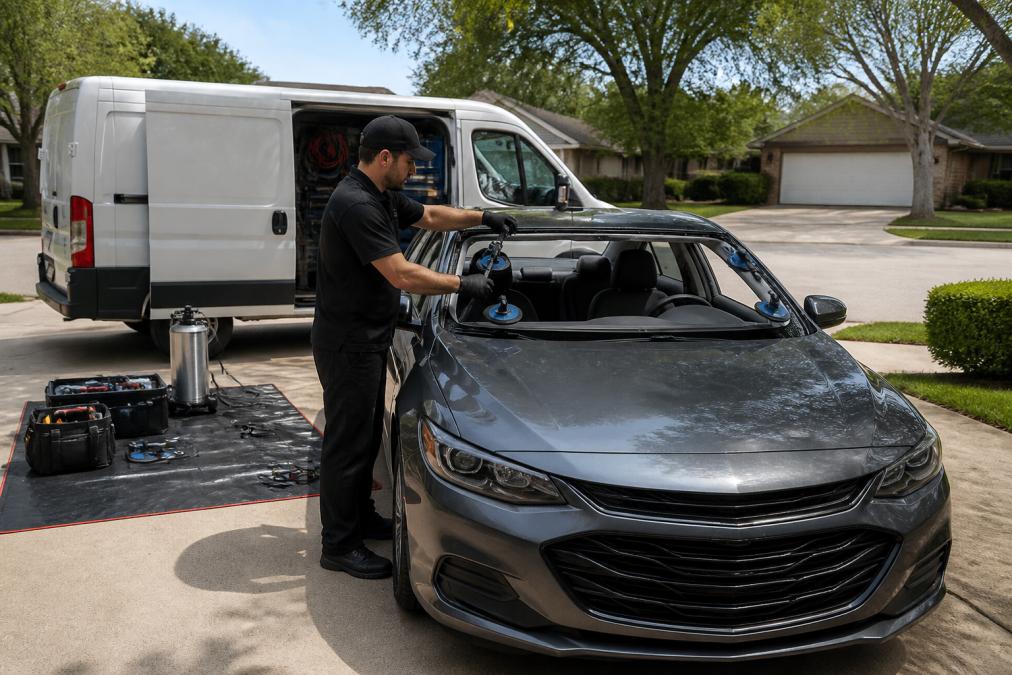
Mobile service brings the entire replacement to your driveway, office lot, or roadside location. A technician arrives with the replacement glass, urethane adhesive, and calibration equipment, then completes the install on site. This removes the need to drop the vehicle off and arrange a ride.
What the technician actually needs from you
Mobile replacement is not a drop-in service. The technician needs a stable work zone, so a few conditions determine whether the job can be completed on site:
- Level ground. The urethane bead sets best when the vehicle is not resting on a slope, because the glass can shift before the adhesive cures.
- Roughly 6 to 8 feet of clearance around the front and sides of the vehicle so the technician can open the hood, reach the cowl, and set tools without stepping into traffic.
- Shade or a covered area when possible. Direct sun and rapid temperature swings affect how the adhesive cures, and most manufacturers specify a temperature range for installation.
- A power source. Many mobile units carry their own inverter or generator, but some calibration setups need a stable 110V outlet. Ask before the technician arrives.
- Access to the interior. The old glass is cut out from inside, so the technician needs to reach the dashboard and the headliner edge.
Mobile vs. shop: the real trade-off
| Factor | Mobile service | Shop visit |
|---|---|---|
| Your time | None beyond the appointment window | Drop-off and pickup, often a full day |
| Environment control | Depends on weather and location | Controlled bay, consistent temperature |
| ADAS calibration | Often done on site with portable targets | Static bay with fixed target boards |
| Best for | Driveway, office lot, fleet yards | Severe damage, complex recalibration |
Mobile service wins on convenience almost every time. The exception is a vehicle that needs static ADAS calibration in a controlled bay with fixed target boards at precise distances. Some mobile units carry portable target systems that meet the same specification, but not all do. Ask the provider to confirm which calibration method your vehicle requires and whether their mobile setup supports it.
Fleet and commercial use
For a fleet manager, mobile service changes the math. A commercial van or truck sitting at a shop is a vehicle not earning. On-site replacement keeps the unit at the yard and returns it to service the same day in most cases. Providers that handle fleet accounts usually schedule multiple vehicles in one visit, which reduces per-vehicle downtime further.
Before the technician arrives, clear the area around the vehicle, move anything that blocks the hood or doors, and have your insurance information and VIN ready. A five-minute prep saves time on site.
How Long Does Windshield Replacement Take?
A standard windshield replacement takes 30 to 90 minutes of hands-on work, but the vehicle is not ready to drive immediately. The urethane adhesive needs time to cure before the windshield can bear structural load.
Here is how the timeline typically breaks down:
| Phase | Duration | What Happens |
|---|---|---|
| Removal | 15-30 minutes | Old glass and adhesive removed |
| Installation | 20-40 minutes | New glass set with urethane |
| ADAS calibration | 30-60 minutes | Camera and sensor systems recalibrated |
| Adhesive cure | 1 hour minimum | Vehicle should not be driven |
ADAS Calibration After Windshield Replacement
ADAS calibration is the process of realigning the cameras and sensors mounted behind the windshield so they read the road correctly. Skipping it leaves lane-keeping, automatic braking, and adaptive cruise control operating on incorrect data.
Two calibration methods exist:
- Static calibration: performed in a controlled bay with target boards at fixed distances
- Dynamic calibration: performed by driving the vehicle under specific conditions so the system self-corrects
Ask for the calibration documentation before the technician leaves. A printed or digital report showing the calibration passed protects you if a sensor issue appears later.
Windshield Replacement Insurance Coverage Explained
Most comprehensive auto insurance policies cover windshield replacement, but the details depend on your deductible and your state’s rules. Comprehensive coverage is the portion of a policy that handles damage not caused by a collision, including broken glass from debris, vandalism, or weather.
The key terms to understand:
- Comprehensive coverage: the policy section that pays for glass damage
- Deductible: the amount you pay before insurance covers the rest
- Full glass coverage: an optional add-on that waives the deductible for glass claims
- Actual cash value vs. replacement cost: whether the payout reflects depreciation or the full cost of new glass
Emergency versus standard: where coverage differs
This is the part most guides skip. An emergency replacement and a scheduled replacement are usually covered under the same comprehensive provision, but the practical differences show up in three places:
- Deductible timing. With a standard repair, you often have time to compare quotes and confirm coverage before authorizing work. In an emergency, you may authorize the job before the claim is filed. If your deductible applies, you are responsible for it regardless of when the claim is submitted.
- Calibration line items. ADAS calibration is sometimes billed as a separate service from the glass replacement. Whether your policy covers it depends on how the claim is coded. Ask the insurer to confirm calibration is included before you authorize the work, not after.
- Towing and roadside. If the vehicle cannot be driven safely, the tow may fall under your roadside assistance benefit rather than the glass claim. These are often separate line items with separate limits.
What to have ready before you call
A five-minute checklist speeds up the claim and prevents a second call:
- Your insurance card or policy number
- Your VIN (visible on the dashboard or driver’s door jamb)
- Photos of the damage from a few angles, including any cracks that reach the edge of the glass
- The date, time, and cause of the damage if you know it
- Your deductible amount and whether you carry full glass coverage
- A note of whether the vehicle has a camera or sensor mounted behind the windshield
Do not authorize a replacement before confirming whether your policy requires pre-approval for glass claims. Some insurers allow direct billing with no prior authorization, while others require a claim number first. Authorizing work outside the process can leave you paying out of pocket and seeking reimbursement later.
Direct billing and reimbursement
When a provider bills your insurer directly, you typically pay only your deductible, if any, at the time of service. When you pay out of pocket and seek reimbursement, you front the full cost and wait for the claim to process. Ask the provider which model they use before booking, and confirm the insurer will accept the provider’s invoice format.
Same-Day and 24/7 Emergency Glass Services
When comparing emergency providers, ask three questions: Can you come today? Is calibration included? Do you bill my insurer directly? The answers separate a genuine emergency service from a standard shop with a phone number.
After a break-in, the priority shifts. Gina Magee of San Antonio described it plainly: “I had my car broken into and needed two passenger windows replaced… they responded very fast and even came out to my house the same day.”
What to Check Before You Book an Emergency Appointment
Verification takes five minutes and prevents a second repair. Run through this checklist before you confirm any appointment:
- Confirm the technician holds current certification (AGSC, NGA, or I-CAR)
- Ask whether the replacement uses OEM glass or aftermarket glass
- Confirm ADAS calibration is included, not billed as an add-on
- Verify direct insurance billing to avoid paying out of pocket
- Ask about the warranty terms, including what voids coverage
- Get the adhesive cure time in writing
- Confirm the provider comes to your location
Frequently Asked Questions
Can I get an emergency windshield replacement at night?
Many mobile auto glass providers offer 24/7 availability, so a nighttime emergency windshield replacement is possible. A technician can come to your home, office, or roadside location and complete the installation using portable lighting. If the damage is a small chip, some companies may recommend a temporary repair until daylight. Call ahead to confirm after-hours scheduling and whether your insurance covers emergency glass services.
How much does windshield replacement cost without insurance?
Out-of-pocket pricing depends on your vehicle’s make, model, and whether it has camera and sensor options that require ADAS calibration. A basic windshield on an older car costs less than a specialized windshield on a newer vehicle with driver-assist features. Area Wide Auto Glass does not publish fixed prices because every job is different. Request a quote on their website for an accurate number before you book.
Can a windshield be replaced in a day?
Yes. Most same-day windshield replacements are completed in 30 to 90 minutes once the technician arrives. The adhesive needs time to cure before you drive, so plan for additional wait time. If your vehicle needs ADAS calibration after windshield replacement, that adds extra time to the appointment. Scheduling early in the day gives you the best chance of same-day completion.
Does mobile windshield replacement cost more than a shop visit?
Mobile service often costs the same as a shop visit because the provider saves on storefront overhead. Some companies charge a small trip fee for remote locations, but many include mobile service in the standard price. For fleet managers with multiple vehicles, on-site installation can reduce downtime and labor costs compared to driving each vehicle to a shop.
A broken windshield is a safety problem, not a cosmetic one, and the right response is fast, verified, and done by a certified technician. Area Wide Auto Glass brings dealership-quality replacement to your home or workplace, with same-day service, certified technicians trained in ADAS calibration, direct billing with all major insurance companies, and a lifetime warranty on materials and labor. Book an appointment with Area Wide Auto Glass and get your vehicle back on the road safely.
