
Table of Contents
- How Long Does Windshield Adhesive Take to Cure? The Short Answer
- Set Time vs. Safe Drive-Away Time vs. Full Cure
- Windshield Urethane Cure Time by Adhesive Type
- What Affects Windshield Adhesive Cure Time
- Windshield Safe Drive-Away Time: When Can You Drive?
- How Long to Wait Before Washing Your Car After Windshield Replacement
- Windshield Replacement Aftercare: A Step-by-Step Checklist
- When to Call a Professional: Warning Signs After Installation
- Frequently Asked Questions
Last Updated: October 5, 2026
How Long Does Windshield Adhesive Take to Cure? The Short Answer
Most drivers want one number, and the honest one is this: you can usually drive again about an hour after installation, but the windshield adhesive keeps curing for days. That gap between “safe to drive” and “fully cured” is where most confusion starts.
At Area Wide Auto Glass, we have installed and replaced auto glass for more than 30 years. The question we hear most is simple: how long does windshield adhesive take to cure? The answer depends on the adhesive, the weather, and the car.
Here is the short version:
- Safe drive-away time: often about 1 hour with modern fast-cure urethane
- Full cure: commonly 24 to 48 hours
- Washing the car: wait at least 24 hours, longer in cold weather
This guide breaks down each stage, what speeds it up or slows it down, and how to protect your new windshield.
Set Time vs. Safe Drive-Away Time vs. Full Cure
These three terms get used as if they mean the same thing. They do not, and mixing them up is the most common mistake we see.
Set time is how long the adhesive needs to hold the glass in place without shifting. Safe drive-away time is when the bond is strong enough for normal driving. Full cure is when the urethane reaches maximum strength.
Think of it like setting concrete. You can walk on a new sidewalk long before it is fully hard. A windshield works the same way.
| Stage | What It Means | Typical Timing |
|---|---|---|
| Set time | Adhesive holds glass in position | 15-60 minutes |
| Safe drive-away | Bond is strong enough to drive | About 1 hour |
| Full cure | Adhesive reaches maximum strength | 24-48 hours |
Safe drive-away time is not the same as full cure. You can drive at one hour, but the bond keeps strengthening for a day or two after that.
Windshield Urethane Cure Time by Adhesive Type
Not all adhesives cure at the same speed, and the product your technician uses sets the timeline. Windshield urethane is a moisture-curing adhesive: it pulls humidity out of the air and reacts with it to cross-link into a solid, rubbery bond.
Standard-cure urethane is the traditional option. It offers excellent bond strength but needs a longer safe drive-away window, often several hours. It is still used in some fleet, heavy-duty, and specialty applications.
Fast-cure urethane is now the norm for most shops. It reaches safe drive-away strength in about an hour under normal conditions. That is why so many replacements let you drive the same day.
Cold-weather formulas are blended for lower temperatures. They cure more slowly than standard products and may need extra time before you drive. Some manufacturers also offer primers and accelerators that change the timeline.
OEM-specified adhesives are sometimes required by the vehicle maker, especially on newer models with advanced driver-assist systems. Using the wrong product can void a warranty or interfere with sensor calibration.
Every adhesive ships with a technical data sheet (TDS) and often a safety data sheet (SDS). The TDS lists the exact set time, drive-away time, full cure time, and the temperature range the product was tested in.
Here is what to look for on the TDS:
- Work time or open time, how long you have to position the glass before the adhesive starts to skin over
- Drive-away time, the manufacturer’s stated minimum before the vehicle can be driven, usually listed at a specific temperature (often 70°F)
- Full cure time, when the bond reaches maximum strength, typically 24 to 48 hours
- Temperature range, the conditions the product was designed for; outside that range, times change
- Substrate notes, whether the adhesive is approved for the specific glass and pinch-weld materials on your vehicle
Ask your installer which adhesive they used and request the technical data sheet. That single question tells you exactly when your car is safe to drive, and it is the same document the shop is supposed to follow.
If a shop cannot tell you the product name or show you a data sheet, that is a warning sign. Reputable installers track this information because it is the basis for their safe drive-away recommendation.
What Affects Windshield Adhesive Cure Time
Cure time is not fixed. Several conditions change how fast the urethane hardens.
Temperature is the biggest factor. Adhesive cures faster in warm conditions and slower in the cold. In winter, safe drive-away time can stretch well past an hour.
Humidity matters too. Urethane needs moisture from the air to cure. Very dry conditions slow the process.
Adhesive type sets the baseline. Fast-cure products beat standard ones on speed.
Installation conditions play a role. A clean, dry surface and a properly seated windshield help the bond form correctly.
Vehicle conditions count as well. A windshield that shifts during cure can weaken the bond.
- Cold weather: add extra time before driving
- High humidity: can speed up curing
- Dry heat: can slow the surface cure
- Wind or dust: can contaminate the bond
Windshield Safe Drive-Away Time: When Can You Drive?
For most modern replacements, you can drive about one hour after the job is done. That is the standard safe drive-away time with fast-cure urethane under normal conditions.
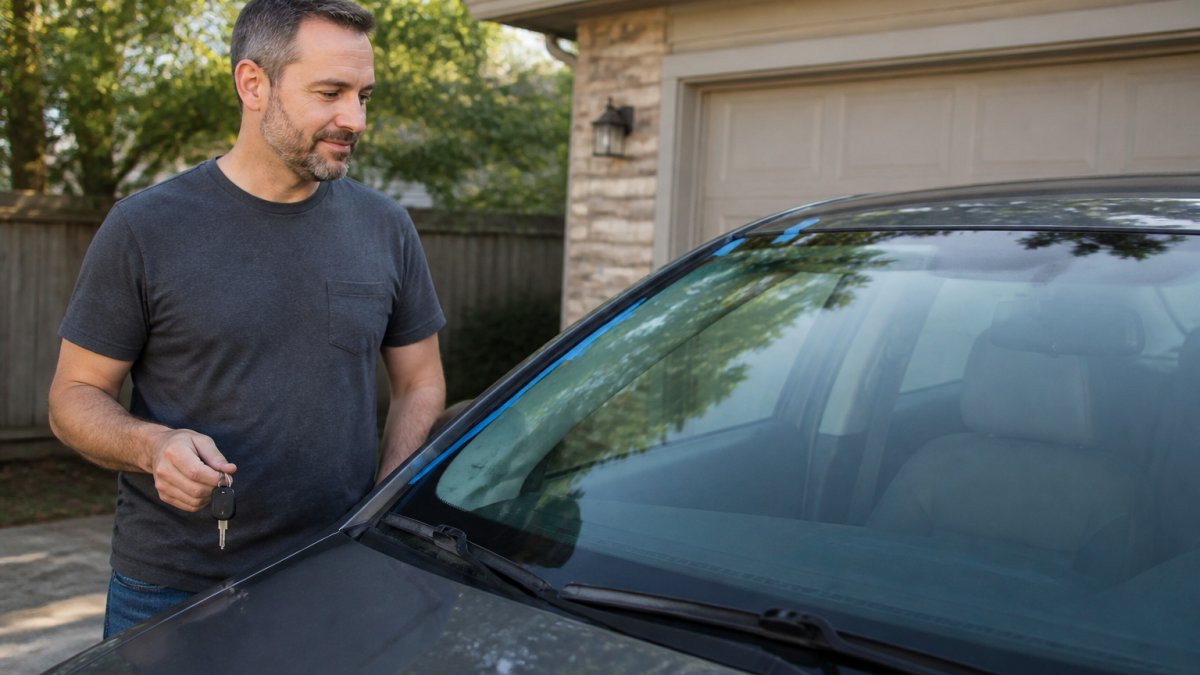
Cold weather changes the math. If the temperature is low, your technician may ask you to wait longer. Always follow their guidance over a general rule.
A few habits protect the bond during those first hours:
- Keep the windows cracked slightly to reduce air pressure
- Avoid slamming doors
- Skip rough roads and speed bumps when you can
- Do not remove retention tape early
Retention tape holds the glass steady while the adhesive sets. Leave it in place until your installer says it is safe to remove.
How Long to Wait Before Washing Your Car After Windshield Replacement
Wait at least 24 hours before washing your car, and longer if the weather is cold. High-pressure water can force its way into a bond that has not fully cured.
Automatic car washes are the bigger risk. The brushes and jets put stress on the glass and the seal. Give the adhesive a full day, ideally two, before you run your car through one.
Hand washing is gentler, but the same rule applies. Keep water away from the edges of the windshield for the first day.
- Wait 24 hours minimum before any washing
- Wait 48 hours before an automatic car wash
- Avoid high-pressure spray near the glass edges
- Skip harsh chemicals on the new seal
Washing too soon can push water into the bond and cause leaks. A leak found later often means the windshield has to come out and be reinstalled.
Windshield Replacement Aftercare: A Step-by-Step Checklist
Good aftercare protects the bond and your safety. Follow these steps after every replacement, and treat the first 24 to 48 hours as the critical window.
First hour
- Wait the full safe drive-away time your installer gives you before driving
- Leave retention tape in place, it holds the glass steady while the adhesive sets
- Keep windows cracked slightly to reduce air pressure inside the cabin
First 24 hours
- Avoid slamming doors, hard braking, and rough roads, these flex the body and can shift the glass before the bond is strong
- Do not remove retention tape early, even if it looks ready
- Skip car washes and high-pressure spray near the glass edges
- Park in a shaded spot in hot weather to avoid uneven curing
- Do not push on the glass or lean on it while closing the door
24 to 48 hours
- Wait at least 24 hours before any washing, and 48 hours before an automatic car wash
- Check for leaks, wind noise, or movement after the first full day
- Schedule ADAS recalibration if your car has driver-assist features
- Keep the receipt and any warranty paperwork with the vehicle
That ADAS step matters more than most drivers realize. Modern windshields often hold cameras and sensors for lane-keeping, automatic braking, and adaptive cruise control. If those systems are not recalibrated after installation, they may not work correctly, and some manufacturers require it as a condition of the warranty.
Why each step matters
The windshield is not just a window. It is a structural component that helps support the roof in a rollover and gives the passenger airbag a surface to push against during deployment. A bond that is still curing may not hold under crash loads. That is why the aftercare window is a safety issue, not just a leak risk.
If you notice water leaks, new wind noise, visible glass movement, or dashboard warning lights for driver-assist systems, contact your installer right away. Do not wait for the next service visit. A windshield that has shifted may need to be removed and reinstalled.
When to call the installer
Most replacements go smoothly, but call your shop if you see:
- Water pooling or dampness along the edges of the glass
- Whistling or wind noise that was not there before
- The glass appears to have shifted in its opening
- Air leaks at speed
- Warning lights for lane-keeping, automatic braking, or other driver-assist features
Keep your installer’s contact information handy for the first week. A quick call is far cheaper than a failed bond, and most reputable shops will inspect the work at no charge if you raise a concern early.
When to Call a Professional: Warning Signs After Installation
Most replacements go smoothly. When something is wrong, the signs show up within the first day or two.
Call your installer right away if you notice:
- Water leaks around the edges of the glass
- Wind noise that was not there before
- The windshield appears to have shifted
- Air leaks or whistling at speed
- Dashboard warning lights for driver-assist systems
Do not ignore these signs. A windshield is part of your car’s structure. It helps support the roof in a rollover and gives the passenger airbag a surface to push against. A weak bond can affect how both perform in a crash.
This is why the cure time matters. A windshield installed correctly, with the right adhesive and the right wait time, does its job. One rushed into service too soon may not.
A windshield replacement is only as good as the adhesive bond behind it. Rushing the cure time risks leaks, wind noise, and weaker crash protection. At Area Wide Auto Glass, our certified technicians use OEM-quality materials, follow each adhesive’s data sheet, and back every job with a lifetime warranty on materials and labor. We come to your home or workplace and handle ADAS recalibration so your safety systems work as designed. Book an Appointment with Area Wide Auto Glass and get dealership-quality glass without the dealership hassle.
Frequently Asked Questions
How soon after a windshield replacement can I drive?
Safe drive-away time depends on the adhesive and conditions. With a one-hour urethane, you can often drive after about 60 minutes. Standard-cure adhesives typically require 8 to 24 hours before driving. Cold or humid weather can extend these windows, so always follow the manufacturer’s instructions and your technician’s guidance before getting behind the wheel.
Does weather affect windshield adhesive curing time?
Yes. Temperature and humidity change how fast urethane adhesive cures. Ideal conditions are around 70°F with moderate humidity. Below 50°F or in high humidity, curing slows and safe drive-away time increases. In hot, dry weather, the surface skin may form faster but full bond strength still takes time. Your installer may use extra retention tape or a longer wait period when conditions are outside the ideal range.
Can I wash my car after a windshield replacement?
Wait at least 24 to 48 hours before washing your car, and avoid high-pressure car washes for the first week. Water forced under the molding can interfere with the urethane bond before it reaches full strength. Hand washing with a gentle stream of water is safer after the initial 24-hour period. Always check your installer’s specific aftercare instructions, as some adhesives require longer.
How long should I leave the tape on after a windshield replacement?
Retention tape holds the glass in place while the adhesive sets. Most manufacturers recommend leaving it on for at least 4 to 6 hours, but some adhesives require 24 hours. Do not remove the tape yourself unless your technician tells you it is safe. Removing it too early can shift the windshield and compromise the seal, leading to leaks or wind noise.