
Table of Contents
- What Luxury Vehicle Owners Need From Mobile Windshield Repair
- How We Evaluated Mobile Windshield Repair Providers
- Area Wide Auto Glass: Mobile Windshield Repair for Luxury Vehicles
- OEM Windshield Glass vs. Aftermarket: What Luxury Vehicles Require
- Windshield Camera Recalibration After Replacement
- Insurance Coverage for Windshield Repair and Replacement
- Windshield Replacement Cost: What Drives Your Out-of-Pocket Total
- Repair or Replace? A Decision Framework for Luxury Glass
- Frequently Asked Questions
Last Updated: October 6, 2026
What Luxury Vehicle Owners Need From Mobile Windshield Repair
A cracked windshield on a luxury vehicle triggers three problems at once: the glass, the camera and sensor systems bonded to it, and the trim and water-sealing that protect a cabin built to tight tolerances. At Area Wide Auto Glass, we have handled these vehicles since 1991.
Below, we break down how to evaluate a mobile provider, what OEM glass means for your car, and why recalibration is not optional on most modern luxury models.
How We Evaluated Mobile Windshield Repair Providers
Most provider roundups rank shops by popularity or star ratings, which tells you little about whether a mobile technician can correctly service a luxury windshield.
The Criteria That Matter for Luxury Glass
| Criterion | Why It Matters on a Luxury Vehicle | Weight |
|---|---|---|
| ADAS calibration capability | Cameras and radar behind the glass must be realigned after replacement; a provider without equipment cannot complete the job | Highest |
| Glass sourcing transparency | OEM vs. OEM-equivalent vs. aftermarket changes optics, acoustic layering, and sensor bracket geometry | High |
| Technician certification | AGSC, NGA, and I-CAR credentials indicate formal training, not just years on the job | High |
| Mobile service readiness | On-site calibration needs level ground, controlled lighting, and target space, not every driveway qualifies | Medium |
| Warranty on parts and labor | Should explicitly cover leaks, wind noise, and calibration, not just the glass | Medium |
| Insurance direct billing | Reduces out-of-pocket friction and prevents surprise calibration line items | Medium |
How to Verify Each Criterion Before You Book
A provider’s website will claim all six. Verification separates real capability from marketing.
Glass sourcing. Ask for the glass part number and manufacturer before installation.
Certification. AGSC registration means the shop follows the AGRSS standard for urethane bonding and safe drive-away times. I-CAR training covers collision-related calibration.
Warranty. Confirm in writing whether the warranty covers calibration if a warning light returns weeks later.
Insurance billing. Ask whether the provider bills the insurer directly or expects upfront payment and reimbursement.
Request the pre-scan and post-scan diagnostic reports in writing. The pre-scan documents existing fault codes so you are not blamed for a pre-existing issue; the post-scan proves calibration completed. Keep both with your service records.
Calibration is where most mobile providers fall short. It requires specific equipment and a controlled space, and many mobile-only operations subcontract or skip it, a safety problem, not a convenience problem.
Area Wide Auto Glass: Mobile Windshield Repair for Luxury Vehicles
Our top pick for luxury owners is Area Wide Auto Glass: it combines mobile convenience with the calibration capability premium vehicles demand.
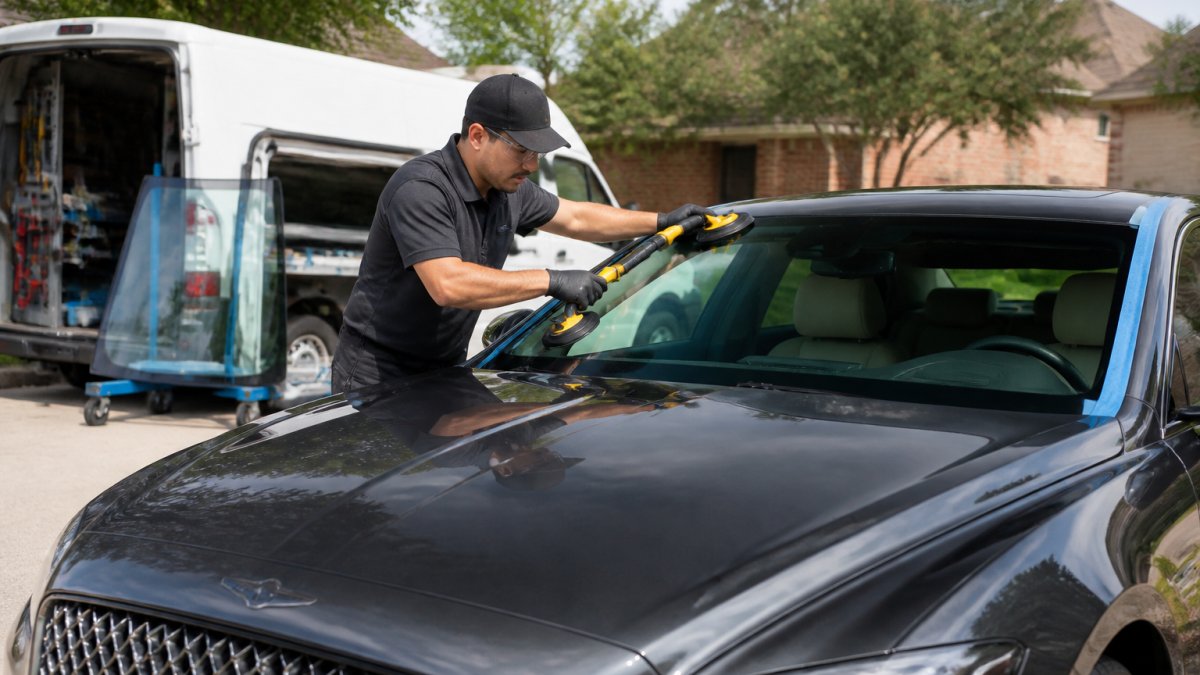
Most replacements are completed in 30 to 90 minutes at your home or workplace, so you are not handing your car to a shop for a day. Direct billing with major insurers keeps the paperwork off your desk.
Strengths and Limitations
What works well:
- Certified technicians trained specifically in ADAS calibration
- Lifetime warranty covering both materials and labor
- Mobile service at your home or workplace
- Direct billing with all major insurance companies
- OEM-quality materials and professional installation
Where it falls short:
- Pricing is quote-based, so you need to request an estimate rather than read a rate card
Ask for the calibration documentation before the technician leaves. On camera-equipped luxury models, a post-install scan report is your proof the system was reset correctly. Keep it with your service records.
OEM Windshield Glass vs. Aftermarket: What Luxury Vehicles Require
OEM windshield glass is manufactured to the vehicle maker’s original specification, including thickness, curvature, tint band, acoustic layering, and mounting points for cameras and rain sensors. Aftermarket glass is made to a generic pattern, and the differences show up over time.
For a luxury vehicle, OEM glass is the safer default for practical reasons:
- Optical clarity. Premium windshields often use acoustic interlayers and distortion-controlled curvature. Cheaper glass can produce slight visual warping at the edges.
- Sensor mounting. Camera brackets must sit at the exact angle the system expects. Small deviations cause calibration failures or lane-keeping errors.
- Fit and sealing. Trim, moldings, and rain channels are designed around the original glass profile.
- Resale and warranty. Some manufacturer warranties and lease agreements require OEM replacement glass.
Installing aftermarket glass on a camera-equipped luxury vehicle without verifying sensor bracket compatibility can cause the ADAS system to fail calibration. The result is a dashboard warning light that will not clear, and you pay twice.
Windshield Camera Recalibration After Replacement
Windshield camera recalibration realigns the forward-facing camera behind your windshield so driver-assistance systems read the road correctly.
There are two methods. Static calibration happens in a controlled space with target boards at measured distances from the vehicle.
Skipping this step is the single most common shortcut in mobile glass work. The National Highway Traffic Safety Administration maintains resources on driver-assistance technology and why these systems depend on correct sensor positioning.
If a provider cannot tell you which calibration method your vehicle needs, that is your answer about their capability.
Insurance Coverage for Windshield Repair and Replacement
Insurance coverage for windshield repair varies by state and policy. Some states require insurers to waive the deductible for repair; others treat it as a standard comprehensive claim. Check your policy and your state’s insurance department guidance. What follows is the framework luxury owners should use to avoid surprise costs.
What Comprehensive Coverage Typically Pays For
- Glass damage from non-collision events, chips, cracks from temperature swings, vandalism, or falling debris, usually falls under comprehensive coverage.
- Deductibles may or may not apply depending on your state and policy. Some states mandate zero-deductible repair; others leave it to the policy.
- Repair over replacement is often encouraged because it costs less and preserves the original factory seal, which matters more on a luxury vehicle than on a basic commuter car.
- Calibration is frequently billed as a separate line item from the glass itself. This is the single most common source of post-repair billing disputes.
The Luxury-Specific Cost Questions to Ask Your Insurer
Before authorizing work, get answers in writing to these four questions. They determine whether your out-of-pocket total matches the quote.
- Is recalibration covered, and at what rate? Some policies cover calibration as part of the glass claim; others cap it or exclude it. Ask for the specific dollar amount your policy allows.
- Does the policy require OEM glass, or will it only pay for aftermarket? Many insurers default to aftermarket or OEM-equivalent glass to control cost. On a vehicle with a heads-up display, acoustic interlayer, or infrared coating, aftermarket glass may not meet the original specification, and you may need to request OEM explicitly.
- Is there a separate deductible for glass versus comprehensive? Some policies apply a lower glass-specific deductible; others use the standard comprehensive deductible.
- Will the insurer pay the mobile service fee? Mobile convenience sometimes carries a trip charge that is not part of the glass claim.
Direct Billing vs. Reimbursement
Direct billing means the provider invoices your insurer and you pay only your deductible, if any. Reimbursement means you pay upfront and file a claim afterward. For luxury glass with calibration, the upfront amount can be substantial, so confirm direct billing before the technician arrives.
If your insurer authorizes aftermarket glass and your vehicle requires OEM specification for the camera bracket or HUD interlayer, calibration may fail or the projection may be distorted. Get the glass specification approved in writing before installation begins.
Total Cost of Ownership Beyond the Claim
Even with full coverage, three costs can land outside the insurance payment:
- Calibration if excluded, often the largest surprise line item.
- Trim and molding replacement, some luxury models use clips and trim that should be replaced rather than reused, and insurers may not cover them.
- Rental or downtime, mobile service reduces this, but if static calibration requires a controlled space, plan for a few hours without the car.
Repair your chip early. A small chip that gets repaired for far less than a full replacement also preserves your factory-installed glass and its original seal, which matters more on a luxury vehicle than on a basic commuter car. And before any replacement, confirm in writing whether calibration is included in the quoted price or billed separately.
Windshield Replacement Cost: What Drives Your Out-of-Pocket Total
Windshield replacement cost depends on four variables: the glass, the calibration requirement, the labor and adhesive system, and your insurance coverage. Luxury glass is built to tighter specifications and often includes acoustic or heated layers, so it sits at the higher end of the range.
The factors that move your total:
- Glass type. OEM glass costs more than aftermarket, and specialty glass with heating elements or acoustic layers costs more still.
- Calibration. Camera recalibration adds a step that basic vehicles do not need.
- Vehicle make and model. Availability and rarity of the glass affect both price and lead time.
- Insurance. Comprehensive coverage and your deductible determine the net cost to you.
- Moldings and trim. Some luxury models use trim pieces that should be replaced rather than reused.
We do not publish flat rates because the variables are too wide to quote responsibly. Request a quote with your VIN so the provider can identify your exact glass specification.
Repair or Replace? A Decision Framework for Luxury Glass
Use the size, location, and depth of the damage to decide. This framework covers the vast majority of cases.
| Damage Type | Typical Recommendation | Why |
|---|---|---|
| Chip smaller than a quarter, away from edges | Repair | Preserves factory seal and costs less |
| Chip in driver’s primary line of sight | Replace | Repair can leave slight optical distortion |
| Crack longer than a dollar bill | Replace | Structural integrity is compromised |
| Damage within 2 inches of the edge | Replace | Edge damage spreads under body flex |
| Multiple chips or a star break | Replace | Repair will not hold across multiple impact points |
| Damage in the camera sensor zone | Replace plus recalibration | Sensor area cannot tolerate any distortion |
Two rules override the table. First, any damage in the camera’s field of view goes to replacement, because sensors read through that glass. Second, if you can feel the damage with a fingernail on the inside surface, the glass is compromised.
If you drive a vehicle with a heads-up display, mention it when you book. HUD windshields use a special wedge interlayer, and generic glass will produce a doubled or blurry projection.
A damaged windshield on a luxury vehicle is a safety issue before a cosmetic one, and calibration is where cheap work quietly fails.
Frequently Asked Questions
Does luxury vehicle windshield replacement require camera recalibration?
Most luxury vehicles built after 2015 have a forward-facing camera mounted behind the windshield that powers lane-keeping, automatic braking, and adaptive cruise control. When the glass is replaced, the camera angle shifts slightly, so windshield camera recalibration is required to restore those systems. Skipping it can leave safety features misaligned or disabled. Ask any mobile windshield repair provider whether recalibration is included in the quote before you book.
Can a mobile technician recalibrate windshield cameras and sensors on site?
Yes, when the provider carries the right equipment. Static recalibration uses target boards placed at measured distances in front of the vehicle, which works in a driveway or parking lot if the surface is level and lighting is consistent. Dynamic recalibration requires a road test at highway speed. Confirm which method your vehicle’s make and model needs, and verify the mobile technician is certified for ADAS work before scheduling.
Should I choose OEM or aftermarket glass for my luxury vehicle?
OEM windshield glass is manufactured to the automaker’s original specifications, including thickness, tint, acoustic dampening, and camera bracket placement. Aftermarket glass can meet safety standards but may differ in optical clarity or sensor alignment, which matters on vehicles with head-up displays or rain sensors. For luxury vehicles, OEM glass usually protects resale value and avoids calibration issues. Ask your provider to confirm the glass source in writing.
How much does mobile windshield replacement cost for a luxury vehicle?
Windshield replacement cost depends on the glass type, vehicle make and model, ADAS recalibration requirements, and whether you use insurance. Luxury vehicles with acoustic glass, heating elements, or camera systems typically cost more than standard replacements because the parts and calibration labor are more involved. Request an itemized quote that separates glass, labor, and recalibration so you can see exactly what you are paying for.
Will insurance coverage for windshield repair cover mobile service and recalibration?
Many comprehensive policies cover windshield repair and replacement, and some waive the deductible for chip repair to encourage fixing damage early. Coverage for ADAS recalibration varies by insurer and state. Mobile service is often included because it costs the insurer less than a shop visit. Before booking, call your insurer and ask three things: your glass deductible, whether recalibration is covered, and whether the provider can bill directly.

