
Table of Contents
- What Mobile Windshield Replacement Actually Involves
- Step-by-Step: How the Mobile Service Workflow Works
- Same-Day Windshield Replacement: How It Works
- ADAS Windshield Calibration: What Dallas Drivers Need to Know
- Windshield Replacement Cost: What Affects Your Price
- DIY Repair Kits vs. Professional Mobile Windshield Replacement
- Weather Conditions and What They Mean for Your Repair
- Conclusion
Last Updated: August 16, 2026
What Mobile Windshield Replacement Actually Involves
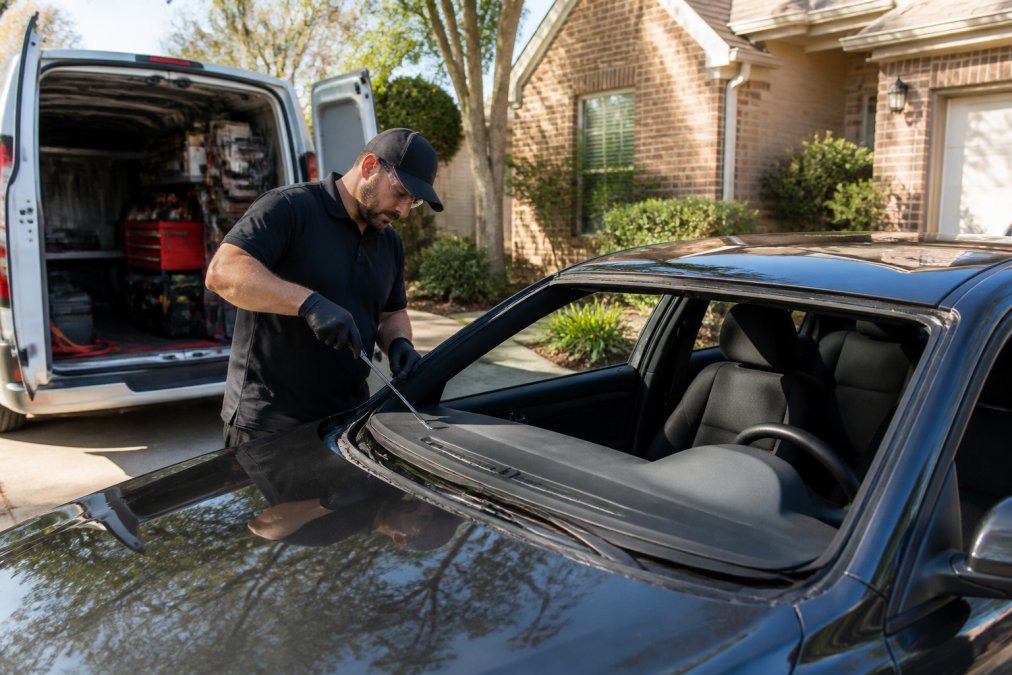
Mobile windshield replacement is a professional auto glass service where a certified technician travels to your location and performs a full glass replacement on-site using the same equipment and materials used in a fixed shop. The process involves removing the damaged glass, cleaning and preparing the frame, applying a urethane adhesive to create a structural seal, setting the new glass, and allowing it to cure before the vehicle is safe to drive. The windshield is a structural component of the vehicle, not just a viewing panel, it contributes to roof crush resistance in rollover accidents and supports proper airbag deployment. A poor installation compromises both.
OEM vs. Aftermarket Glass: Which One Do You Need?
OEM glass (Original Equipment Manufacturer) is produced to the same specifications as the factory glass. Aftermarket glass meets minimum federal safety standards but tolerances for thickness, curvature, and optical clarity can vary. For vehicles with embedded rain sensors, heads-up displays, or forward-facing cameras mounted to the windshield, OEM glass is strongly recommended because sensor calibration and camera alignment depend on precise optical properties.
If your vehicle has a heads-up display or a front-facing camera, confirm with your technician whether your replacement glass is OEM-spec before the appointment.
Laminated vs. Tempered Glass: Why It Matters for Safety
Laminated glass is the standard for windshields, two layers of glass bonded to a plastic interlayer so it holds together when broken. Tempered glass is used for side and rear windows and breaks into small, relatively harmless granules. A windshield replacement always uses laminated glass. Per NHTSA’s Federal Motor Vehicle Safety Standards, glazing materials must meet specific performance requirements, and your technician should confirm compliance.
Step-by-Step: How the Mobile Service Workflow Works
Professional mobile units carry everything a fixed shop does: glass inventory, adhesive systems, removal tools, and cleaning supplies.
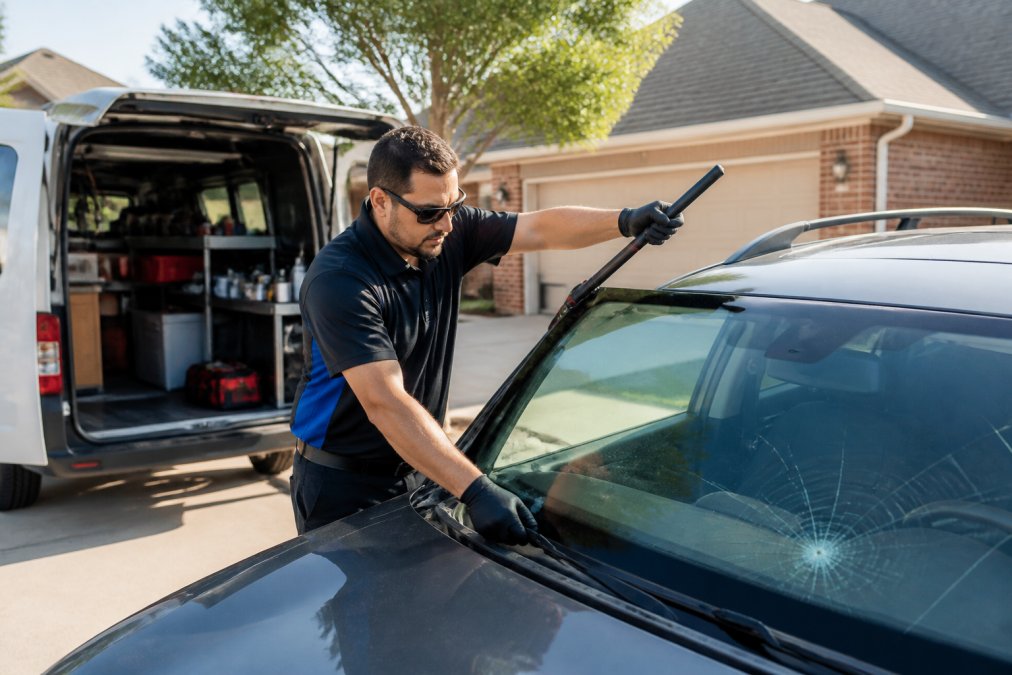
Here’s how the workflow unfolds:
- Scheduling and confirmation – You request service, provide your vehicle details, and confirm your location.
- Arrival and vehicle assessment – The technician inspects the damage and checks for frame damage or weather stripping issues.
- Old glass removal – Using specialized tools, the technician removes the damaged glass without damaging the pinch weld or trim.
- Frame preparation – The frame is cleaned, primed, and inspected. Any rust or debris is addressed.
- Adhesive application – A urethane glass adhesive is applied in a continuous bead around the frame, creating the structural bond and weather seal.
- Glass installation – The new windshield is positioned, aligned, and set. Moldings and trim are reinstalled.
- Final inspection – The technician checks the seal and verifies proper fit.
What to Expect on the Day of Service
Most mobile windshield replacements take between 30 and 90 minutes. Park your vehicle in a flat, accessible spot with at least three feet of clearance on the side being worked on.
Drive-Away Time and Curing Requirements
Drive-away time is the minimum period you must wait after installation before driving. Most modern adhesives reach minimum safe drive-away strength within one hour under normal conditions, though full cure typically takes 24 hours. Cold temperatures, high humidity, and very low humidity extend curing time. Your technician should give you a specific drive-away time based on conditions at installation.
Same-Day Windshield Replacement: How It Works
Same-day windshield replacement is available when the required glass is in stock and a technician slot is open. For common vehicle makes and models, glass availability is rarely the bottleneck. For fleet managers running commercial vehicles, same-day service is particularly valuable because vehicle downtime directly affects operations.
Same-day service is most reliable when you contact the provider early in the day with your vehicle’s year, make, model, and VIN ready.
ADAS Windshield Calibration: What Drivers Need to Know
ADAS calibration is required after windshield replacement on any vehicle equipped with Advanced Driver Assistance Systems. ADAS includes lane departure warning, automatic emergency braking, adaptive cruise control, and forward collision warning, all relying on sensors and cameras mounted at or near the windshield. When a windshield is replaced, the camera mounting position shifts, even fractionally, throwing off the sensor’s field of view. According to the Insurance Institute for Highway Safety’s research on ADAS accuracy, the performance of these systems is highly sensitive to proper calibration.
Which Vehicles Require Recalibration After Glass Replacement?
Most vehicles manufactured after 2018 require some form of ADAS recalibration after windshield replacement. There are two types:
- Static calibration requires the vehicle to be parked with specific target boards placed at precise distances in front, using specialized software.
- Dynamic calibration requires driving the vehicle at a set speed on a road with clear lane markings while the system recalibrates using real-world data.
Some vehicles require both. If your provider doesn’t mention calibration and your vehicle has ADAS features, ask directly before installation.
Windshield Replacement Cost: What Affects Your Price
Windshield replacement cost varies based on glass type (OEM vs. aftermarket), vehicle complexity, ADAS calibration requirements, and glass features like rain sensors or tint. For an accurate figure, request a quote based on your specific vehicle.
| Factor | Impact on Cost |
|---|---|
| OEM vs. aftermarket glass | OEM typically costs more; required for sensor-equipped vehicles |
| ADAS calibration | Adds cost when required; critical for vehicle safety |
| Vehicle make and model | Luxury and newer vehicles carry higher glass costs |
| Glass features | Rain sensors, tint, acoustic interlayer increase price |
| Insurance coverage | May eliminate or reduce out-of-pocket cost entirely |
How to Navigate Your Insurance Claim
Most comprehensive auto insurance policies cover windshield replacement, and many waive the deductible entirely for glass claims. Here’s how to approach it:
- Check your policy – Confirm you have comprehensive coverage.
- Contact your insurer or your glass provider – Many auto glass providers handle direct billing with major insurance carriers.
- Confirm deductible status – Some states and policies waive the glass deductible.
- Ask about ADAS calibration coverage – Calibration is a separate line item, and not all insurers automatically include it. Get written confirmation before the appointment.
- Authorize the work – Once billing is confirmed, the appointment is scheduled and the insurer pays the provider directly.
Do not assume ADAS calibration is included in your insurance claim without confirming it explicitly. An uncalibrated ADAS system after glass replacement is a safety hazard.
DIY Repair Kits vs. Professional Mobile Windshield Replacement
Windshield repair kits are designed for one specific scenario: a small chip, no larger than a quarter, that hasn’t reached the edges and hasn’t compromised the inner layer of laminate. The biggest risk with DIY kits is a repair that looks successful but leaves structural integrity compromised. A chip filled with resin may still propagate into a full crack under thermal stress or road vibration.
Professional mobile windshield replacement addresses damage that DIY kits cannot. For anything larger than a small chip, anything near the edges, anything on a vehicle with ADAS, or anything you’re unsure about, professional service is the correct call.
Weather Conditions and What They Mean for Your Repair
Weather affects both scheduling and outcome of mobile windshield replacement. Urethane adhesive has an optimal application temperature range. Very cold temperatures slow the cure rate and can affect adhesion quality. Very high temperatures can accelerate curing in ways that reduce working time. Technicians adjust adhesive formulas or schedule work during cooler parts of the day.
Rain is manageable with a covered workspace, but installing glass in direct rain without shelter is not standard practice. A garage, carport, or covered parking structure is ideal in wet conditions. Extreme heat in summer affects glass and adhesive response to ambient temperature. Mention this when scheduling so the technician can plan accordingly.
According to the Auto Glass Safety Council’s installation standards, proper adhesive application and curing conditions are foundational to a safe installation.
Conclusion
Damaged glass doesn’t get better on its own, and the longer a chip or crack is left unaddressed, the more likely it is to spread into a full replacement situation. Area Wide Auto Glass brings certified technicians directly to your location, with same-day availability, direct insurance billing, and a lifetime warranty on all materials and labor. Our technicians hold AGSC, NGA, and I-CAR certifications and are trained to handle ADAS calibration on modern vehicles. Get started with Area Wide Auto Glass and have your windshield replaced correctly, at your location, with zero guesswork on insurance or safety compliance.
Frequently Asked Questions
How long does mobile windshield replacement take?
Most mobile windshield replacements are completed in 30 to 90 minutes. The technician removes the damaged glass, cleans the frame, applies fresh adhesive, seats the new windshield, and checks the seal. After installation, there is a mandatory curing period before you can drive. Area Wide Auto Glass technicians will give you a specific drive-away time based on your vehicle and the adhesive used, which typically ranges from one to several hours.
Does Texas have a free windshield replacement program?
Texas does not have a state-mandated free windshield replacement program. However, if your auto insurance policy includes comprehensive coverage, your insurer may cover windshield repair or replacement with little or no out-of-pocket cost to you, depending on your deductible. Area Wide Auto Glass handles direct billing with all major insurance carriers, so you can find out quickly what your policy covers before committing to any work.
Can a cop pull you over for a cracked windshield in Texas?
Yes. Under Texas Transportation Code, a law enforcement officer can issue a citation if a cracked or chipped windshield obstructs the driver's view. Cracks in the driver's primary line of sight are the most common reason for a stop. Beyond the legal risk, a compromised windshield weakens the vehicle's structural integrity in a rollover. Scheduling a mobile windshield replacement before the damage spreads protects both your safety and your driving record.
Do I need to be present for mobile windshield replacement?
You do not need to stand next to your vehicle the entire time, but someone with authorization to release the vehicle should be available at the start of service. The technician needs access to the car and may need a signature for insurance paperwork. Once the job is underway, you can return to work or home. Area Wide Auto Glass will confirm all logistics when you book your appointment so there are no surprises on the day of service.
This article was written using GrandRanker


