
Table of Contents
- What Happens When ADAS Calibration Is Missed or Done Wrong
- Signs of Bad ADAS Calibration You Should Never Ignore
- How Long Does ADAS Calibration Take and What the Process Involves
- ADAS Calibration Cost: What Affects the Price You Pay
- The Role of Wheel Alignment in Sensor Accuracy
- Insurance, Warranty, and Legal Consequences of Improper Calibration
- How to Verify Your ADAS Calibration Was Done Right
- Frequently Asked Questions
Last Updated: September 29, 2026
What Happens When ADAS Calibration Is Missed or Done Wrong
Advanced driver assistance systems (ADAS) is the network of cameras, radar, and sensors that helps your car brake, steer, and warn you before a crash. When a windshield is replaced, those sensors can shift by a fraction of an inch. That tiny shift is enough to throw off everything they do.
So what happens if ADAS is not calibrated correctly? Your safety features can fail when you need them most. Lane departure warning may pull you toward the wrong line. Automatic emergency braking may not fire at all. And if you’re in a crash, the fault could land on you.
At Area Wide Auto Glass, our certified technicians are trained in ADAS calibration. A driver gets a new windshield at a shop that skips calibration. Weeks later, the dashboard lights up with warnings.
Here’s what most guides get wrong: they treat calibration as optional. It isn’t. It’s part of the repair.
How Camera Misalignment Affects Sensor Fusion
Sensor fusion is the process where your car’s computer blends data from cameras, radar, and other sensors into one clear picture of the road. If the camera is off by even a small amount, that picture gets blurry.
Think of it like two people describing the same scene. If one is standing in the wrong spot, their description won’t match the other. The car’s computer faces the same conflict. It may ignore the camera, trust the radar too much, or freeze up entirely.
The result is a system that reacts late, or not at all.
Signs of Bad ADAS Calibration You Should Never Ignore
The clearest sign of bad calibration is a warning light that won’t go away. Many cars show a message like “Forward Camera System Unavailable” or “Lane Keeping Assist Fault.” If that light stays on after a windshield replacement, the calibration was skipped or done wrong.
Other signs of bad ADAS calibration include:
- Lane departure warning that beeps for no reason
- The car drifting toward a lane line before correcting
- Automatic emergency braking that never triggers in traffic
- Adaptive cruise control that speeds up or slows down oddly
- Blind spot monitoring that misses cars you can see
A common mistake is assuming these are “just glitches.” They’re not. They’re your car telling you the sensors don’t agree with reality.
Ignoring a calibration warning light doesn’t make it go away. It means your collision avoidance system may not work in an emergency, and that gap can turn a fender bender into something far worse.
How Long Does ADAS Calibration Take and What the Process Involves
Most ADAS calibrations take 30 to 90 minutes, though some vehicles need longer. The time depends on the car, the sensor type, and whether the shop uses static or dynamic methods.
The process itself has a few clear steps:
- Scan the vehicle for diagnostic trouble codes
- Check tire pressure and wheel alignment
- Position the car on a level surface
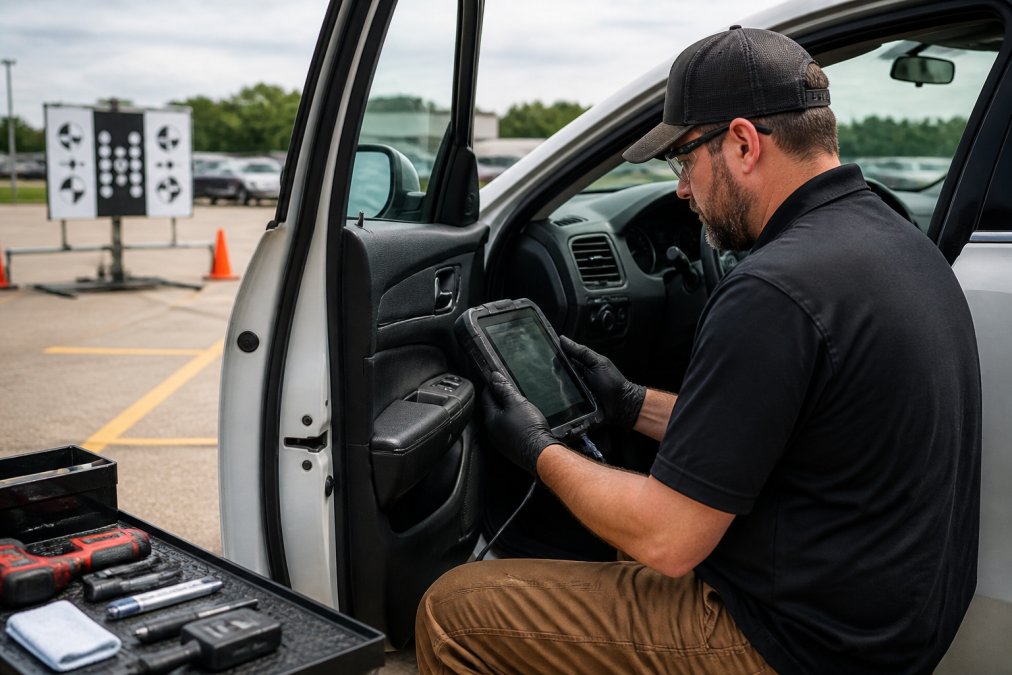
- Set up calibration targets at exact distances
- Run the factory software to reset the sensors
- Test drive or re-scan to confirm the fix
Skipping any step leaves the system guessing.
Static vs Dynamic Calibration Explained
Static calibration uses physical targets placed at set distances in front of the car. The vehicle stays parked while the cameras and radar align to those targets. It’s precise and works for most modern vehicles.
Dynamic calibration requires a test drive at specific speeds on clear roads. The car’s computer learns from real-world conditions as you drive. Some automakers require this method, and some require both.
Neither method works if wheel alignment is off.
ADAS Calibration Cost: What Affects the Price You Pay
Pricing depends on several factors, so there’s no single number that fits every car. The main drivers are:
- The make and model of your vehicle
- How many sensors need calibration
- Whether the shop uses static, dynamic, or both methods
- Whether wheel alignment is included
- Whether the work is billed through insurance
Pricing depends on several factors, so there’s no single number that fits every car. The spread is wide because the labor and target setup, not the software, drive the bill. A shop that has to reposition targets for four separate sensors is doing four times the work of a shop calibrating one camera.
Luxury vehicles with multiple cameras and radar units take longer and need more equipment.
Why Some Drivers Pay for Calibration Twice
Ask upfront whether calibration is included before you approve any windshield work, and get that answer in writing on the estimate.
How to Keep Calibration Costs Out of Your Pocket
If the windshield replacement is tied to an insurance claim, calibration is usually a covered part of the repair, not a separate add-on you should absorb. The key is to confirm coverage before the work begins. Ask the shop whether they will bill the calibration line item directly to your insurer, and ask your insurer whether recalibration is included in the glass coverage or treated as a separate mechanical service.
Before you approve any windshield work, ask three questions in writing: Is calibration included? Is wheel alignment checked first? Will I receive a calibration report? A shop that hesitates on any of these is a shop that may skip the step.
The Role of Wheel Alignment in Sensor Accuracy
Wheel alignment directly controls where your car points, and your ADAS sensors are aimed relative to the wheels. If the alignment is off, the sensors are aimed wrong, even after a perfect calibration.
Insurance, Warranty, and Legal Consequences of Improper Calibration
Insurance claims get complicated when calibration is skipped. Many insurers now require proof that recalibration was done after a windshield replacement. Without that proof, a claim related to a safety system failure may be denied.
How to Make Sure Calibration Is Included in Your Insurance Claim
This is the part most guides skip, and it’s the part that protects your wallet. If your windshield replacement is part of a comprehensive or collision claim, follow these steps in order:
- Report the claim before the repair, not after. Insurers want to authorize the scope of work up front. A calibration line item added after the fact is easier for an adjuster to question.
- Ask the adjuster directly whether recalibration is covered. Use the phrase ‘ADAS recalibration’, not ‘sensor reset’ or ‘computer reset.’ The specific term maps to a specific line item in most estimating systems.
- Get the authorization in writing. An email or claim note confirming calibration is covered is your proof if the payment is later reduced.
- Choose a shop that bills insurance directly. A shop that handles the paperwork removes you from the middle of the dispute.
- Keep the calibration report with your claim file. If the insurer ever questions the repair, that report is your evidence the work was done to factory specification.
Warranty Coverage: The Bigger Risk
Warranty coverage is a bigger risk than insurance. If a dealer can show that an aftermarket repair left the ADAS system uncalibrated, they may void the warranty on those parts. That leaves you paying for repairs a warranty should cover.
The Legal Angle
There’s also a legal angle. If your collision avoidance system fails in a crash and investigators find it was never calibrated, fault can shift to you. That can affect liability, insurance rates, and in serious cases, legal exposure.
A calibration report is not just a receipt. It is the document that protects you in an insurance dispute, a warranty claim, and a liability investigation. If a shop cannot produce one, treat the repair as incomplete.
How to Verify Your ADAS Calibration Was Done Right
Verification starts before you drive away. Ask for the calibration report. It should list the sensors calibrated, the method used, and the result.
Then run your own checks:
- Start the car and look for warning lights
- Test lane departure warning on a marked road
- Confirm adaptive cruise control holds a steady gap
- Check that blind spot monitoring alerts on passing cars
- Note any odd steering or braking in the first few drives
If something feels off, go back. Don’t wait.
Diagnostic Self-Check and Post-Repair Testing
A diagnostic self-check uses the car’s own computer to confirm the sensors are talking to each other. Many vehicles run this automatically at startup. If a fault appears, it stores a code the shop can read.
Never accept a windshield replacement without a calibration report. That single document is your proof the safety systems were reset to factory specifications.
Frequently Asked Questions
How much does it cost to recalibrate the ADAS system?
ADAS calibration cost varies based on your vehicle’s make and model, the type of calibration required (static, dynamic, or both), and whether the work is bundled with a windshield replacement. Some vehicles need only a short dynamic drive cycle, while others require a controlled static setup with targets. Area Wide Auto Glass bundles recalibration with windshield replacement and works directly with insurance companies to minimize your out-of-pocket expense. Contact them for a quote specific to your vehicle.
Can I do ADAS calibration myself?
No. Proper ADAS calibration requires factory-level diagnostic tools, manufacturer-specific calibration targets, and a controlled environment with precise lighting and spacing. Without these, camera misalignment and radar calibration errors can persist even if the system appears to function. Certified technicians trained through programs like I-CAR and Delta use the correct equipment and follow factory specifications. Attempting a DIY calibration risks your safety and may void your warranty.
What happens if calibration is wrong?
Incorrect calibration causes vehicle safety features to behave unpredictably. Lane departure warning may trigger false alerts or miss lane markings entirely. Automatic emergency braking could fail to detect obstacles or brake unnecessarily. Adaptive cruise control may misjudge following distance. These failures happen without warning, which is why post-repair testing and diagnostic trouble code scans matter. If your system was calibrated wrong, the vehicle may not show any dashboard warning at all.
Does insurance cover ADAS recalibration after a windshield replacement?
In most cases, yes. When recalibration is a required step of the windshield replacement, many insurance policies cover it as part of the claim. Coverage depends on your specific policy and deductible. Area Wide Auto Glass bills insurance companies directly and can confirm what your plan covers before work begins. If recalibration is not included in your glass coverage, ask whether it falls under your comprehensive or collision coverage instead.

