
Table of Contents
- What ADAS Recalibration Means and Why It Matters
- How ADAS Sensors Work and How They Lose Accuracy
- When Is ADAS Recalibration Required?
- Safety Risks of Driving With Misaligned Sensors
- Static vs Dynamic ADAS Calibration: Which Method Does Your Vehicle Need?
- How Long Does ADAS Calibration Take?
- DIY vs Professional Calibration, Insurance, and Post-Repair Verification
- Conclusion
- Frequently Asked Questions
Last Updated: October 1, 2026
What ADAS Recalibration Means and Why It Matters
ADAS recalibration is the process of restoring accurate alignment between a vehicle’s advanced driver assistance systems and the road ahead. It matters because a camera aimed even slightly off can misjudge distance, delay braking, or miss a lane marking entirely. At Area Wide Auto Glass, we treat recalibration as the final safety step of every windshield job on a sensor-equipped vehicle, not an optional add-on.
How ADAS Sensors Work and How They Lose Accuracy
Your vehicle’s safety features depend on a small cluster of sensors reading the world through your windshield. Cameras watch lane markings and objects ahead. Radar measures distance and closing speed. Lidar, where fitted, builds a detailed picture of the surroundings. Each one sends data to a computer that decides when to brake, steer, or warn.
The Four Mechanisms That Push a Sensor Out of Alignment
Accuracy is lost through a small number of physical mechanisms, and knowing them explains why recalibration is not optional:
- Mounting geometry shift. The camera bracket is bonded or bolted to the windshield or the body structure behind it. Replacing the glass means breaking that bond and re-establishing it. Adhesive thickness, bracket torque, and the position of the new glass in the urethane bed all vary slightly from the factory jig. A millimeter of bracket movement translates to a meaningful angular error at distance.
- Optical distortion from the glass itself. Windshield glass is not perfectly flat or uniform. Curvature, thickness, and the interlayer between the two panes vary between manufacturers and even between production runs. A camera calibrated to the optical properties of one windshield is looking through a different lens after replacement.
- Ride height and vehicle attitude. Suspension work, a wheel alignment, new tires, or a heavy load in the trunk changes the angle of the vehicle relative to the road. Cameras and radar are calibrated to a reference attitude. Change the attitude and the reference is wrong.
- Thermal and vibration drift over time. Even without a repair, brackets can shift from thermal cycling and road vibration. This is why some manufacturers specify periodic calibration checks, not just post-repair ones.
Camera Aim, Sensor Mounting, and Factory Specifications
Camera aim is the direction the sensor points relative to the vehicle’s centerline and the road surface. Sensor mounting is the hardware that holds it in place, and factory specifications are the exact tolerances the manufacturer sets for both. A camera that is a degree off can read a lane marking as being where it isn’t, which is enough to trigger a false warning or delay a real one.
The key insight is that ADAS accuracy is a geometry problem, not an electronics problem. The sensor itself rarely fails. What fails is the relationship between the sensor and the road, and that relationship is disturbed by almost every repair that touches the windshield, suspension, or body structure.
When Is ADAS Recalibration Required?
ADAS recalibration is required any time the camera’s view or mounting position changes. The most common trigger is windshield replacement, but it is not the only one. If you are unsure whether your vehicle needs it, the answer usually lives in the owner’s manual or on a sticker near the camera housing.
Here are the situations that typically call for recalibration:
- Windshield replacement on any vehicle with a camera or sensor behind the glass
- Collision repair that disturbs the windshield frame or roofline
- Suspension work or a wheel alignment that changes ride height
- Replacement of the camera or radar unit itself
- A dashboard warning light for a driver assistance feature
Windshield Replacement and Other Common Triggers
Windshield replacement is the trigger most drivers encounter, and it is the one that catches people off guard. The new glass is never an exact physical match for the old piece, even when it comes from the same manufacturer. Small differences in curvature and thickness change where the camera sits. That is why a reputable shop treats recalibration as part of the job rather than a separate service you have to remember to request.
Safety Risks of Driving With Misaligned Sensors
Misaligned sensors create two failure modes, and both are dangerous. The system can miss a real hazard, or it can react to something that isn’t there. A driver who has learned to trust automatic emergency braking may not brake in time when the system stays silent because its camera is aimed at the sky.
Static vs Dynamic ADAS Calibration: Which Method Does Your Vehicle Need?
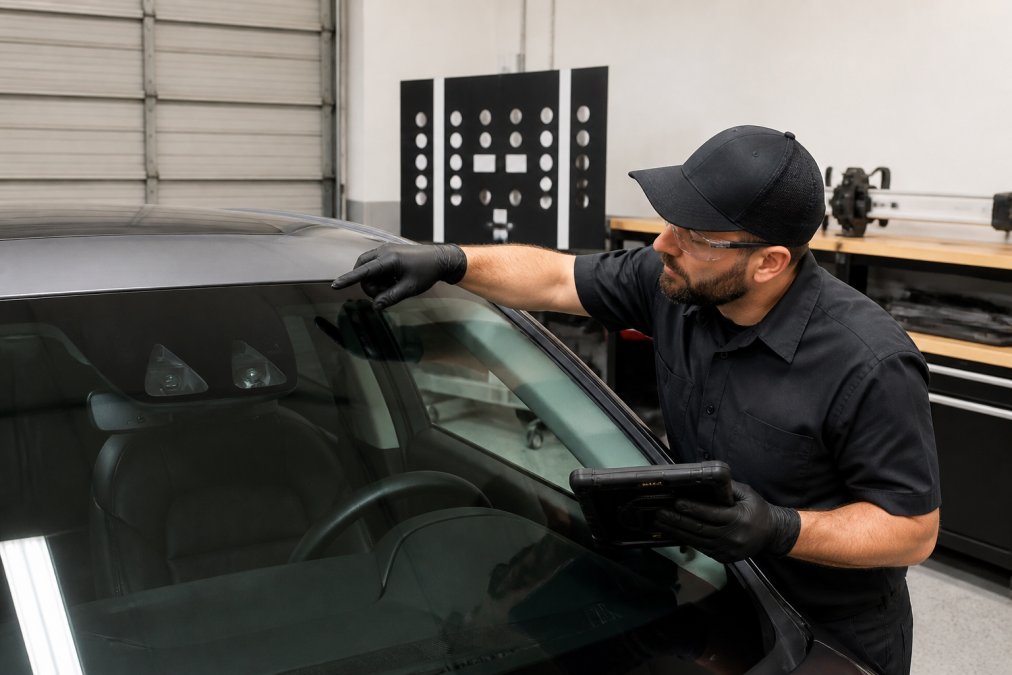
Your vehicle, not your preference, decides which calibration method applies. Static calibration uses a controlled setup in a shop bay with targets placed at measured distances in front of the vehicle. Dynamic calibration requires driving the vehicle at specified speeds on a clear road so the system can relearn its reference points. Some vehicles need one method. Some need both.
| Method | How It Works | Where It Happens | Typical Fit |
|---|---|---|---|
| Static | Targets positioned at measured distances | Shop bay, controlled lighting | Vehicles with tight camera tolerances |
| Dynamic | Vehicle driven at set speeds and conditions | Open road, specific speed range | Vehicles that self-learn reference points |
| Combined | Static setup, then a verification drive | Shop, then road | Vehicles requiring both procedures |
Never assume a calibration carried out for a different trim level or model year applies to your vehicle. Camera mounting positions and target distances change between generations, and using the wrong procedure can leave the system further out of alignment than before.
How Long Does ADAS Calibration Take?
ADAS calibration typically adds time to a windshield replacement rather than replacing it. A dynamic calibration may take a short drive once the glass is set. A static calibration takes longer because the vehicle must be positioned precisely and the targets placed to exact measurements. Combined procedures take longest of all.
DIY vs Professional Calibration, Insurance, and Post-Repair Verification
This is the section most guides skip, and it is where drivers actually get stuck. The technical case for calibration is settled. The open questions are whether you can do it yourself, who pays, and how you know it was done right.
Why DIY Calibration Is Not a Realistic Option
DIY recalibration is not a realistic option for the vast majority of drivers, and the reasons are concrete rather than gatekeeping:
- Manufacturer-specific targets. Each automaker publishes its own target boards, target distances, and target heights. A generic target set will not match the procedure your vehicle’s computer expects.
- A level, measured surface. Static calibration requires the vehicle to sit on a surface that is level within a tight tolerance, often a fraction of a degree. A typical driveway or garage floor does not qualify.
- A scan tool that can enter calibration mode. Reading codes is not the same as commanding a calibration. The tool must be able to put the module into the correct service mode, and that capability is licensed per manufacturer.
- Environmental control. Lighting, reflections, and even the color of the floor can interfere with camera-based procedures. Shop bays are set up to control for this.
Does Insurance Cover ADAS Calibration?
Many policies that cover windshield replacement also cover the recalibration the replacement requires, because the two are treated as part of the same repair. Whether your specific policy does depends on a few variables:
- Comprehensive coverage. In most states, windshield replacement is handled under the comprehensive portion of an auto policy. If calibration is required to complete that repair, it is typically included in the claim.
- State glass rules. Some states require insurers to waive the deductible for windshield replacement specifically. Whether that waiver extends to calibration varies, so it is worth asking directly.
- Repair vs. replacement. A chip repair that does not disturb the camera bracket usually does not trigger calibration. A full replacement on a sensor-equipped vehicle usually does.
- Aftermarket vs. OEM glass. Some policies specify aftermarket glass. Aftermarket windshields can have different optical properties, which can affect whether calibration is required and how it is performed.
How to Verify the Calibration Was Done Correctly
- No active fault codes in the ADAS modules after the procedure.
- A documented calibration report showing the procedure performed and the result.
- A test drive or static re-check confirming the system reads correctly after the procedure.
Before you leave the shop, ask two questions: “Which calibration procedure did my vehicle require, and can I see the report?” A shop that can answer both is a shop that did the work.
Fleet managers face the same question at scale. When you run dozens of vehicles across multiple locations, calibration records matter as much as the repair itself. Mobile service that comes to your yard or office keeps vehicles in rotation instead of parked at a shop, and documented calibration protects you if a driver assistance feature is ever called into question after an incident.
Conclusion
The gap between a properly calibrated vehicle and one that merely had its glass replaced is invisible until the moment it matters. Driver assistance technology only performs as designed when its sensors are aimed to factory specifications, and that alignment is lost the moment the windshield changes.
Frequently Asked Questions
Is ADAS recalibration necessary after a windshield replacement?
Yes, in most modern vehicles. The forward-facing camera that powers lane departure warning and automatic emergency braking mounts to the windshield. Removing and reinstalling that glass changes the camera angle by fractions of a degree, which is enough to throw off hazard detection. Most automakers specify recalibration after replacement, so skipping it can leave safety features aiming at the wrong part of the road.
What happens if you don’t calibrate your ADAS sensors?
Uncalibrated sensors can misread lane markings, brake for shadows or roadside objects, or fail to detect a vehicle ahead in time. You may see false warnings or, worse, no warning at all when you need one. Because these systems feed collision avoidance and adaptive cruise control, a misaligned camera undermines the exact safety functions you paid for.
Can I do ADAS calibration myself?
Professional calibration requires specific targets, measured distances, level floors, and a diagnostic scan matched to your vehicle’s factory specifications. Static setups alone can need several meters of clear, flat space and precise target placement. Without the right equipment and software, the system may appear to pass while camera aim stays off, so this is one job best left to certified technicians.
How long does ADAS calibration take?
Dynamic calibration usually adds a short road test of roughly 10 to 30 minutes once the windshield is installed. Static calibration takes longer because the vehicle must be positioned in front of targets at exact distances, often 30 to 60 minutes or more depending on the make and model. Some vehicles require both methods, so plan for the work to take a few hours in total.