
Table of Contents
- Windshield Replacement Cost: What Actually Drives the Price
- ADAS Windshield Calibration: Why a New Windshield Isn’t Enough
- OEM vs Aftermarket Windshield: Which Glass Belongs on Your Car
- How Mobile Windshield Replacement Works, Step by Step
- Comparing Your Windshield Replacement Service Options
- Certifications and Warranties That Separate Shops
- Conclusion
- Frequently Asked Questions
Last Updated: October 3, 2026
Windshield Replacement Cost: What Actually Drives the Price
Windshield replacement is the full removal and installation of your vehicle’s front glass, and the final bill depends on three things: glass type, vehicle technology, and labor. At Area Wide Auto Glass, we’ve handled these jobs, and the pattern is consistent. Two drivers with the same car model can pay very different amounts because one has a camera behind the glass and the other doesn’t.
Here’s the part most quotes hide: the glass itself is often the smaller line item. The labor and the calibration are what move the number.
Repair vs. Replacement: The Decision Line
Repair wins when damage is small and away from the edges. A stone chip or small cracked windshield mark under the size of a quarter, outside the driver’s direct line of sight, is usually a repair candidate.
Replacement becomes necessary when:
- The damage sits in the driver’s primary viewing area
- A crack runs to the edge of the glass
- The damage penetrates the inner layer of the laminated glass
- A stress crack has started spreading on its own
The rule we give customers: if you can cover the damage with a credit card and it’s not in your sight line, ask about chip repair first. Anything larger, or anything creeping, needs a full windshield replacement service.
Insurance Deductibles and Comprehensive Coverage
Most comprehensive coverage policies treat glass differently from collision damage. In many states, insurers must waive the insurance deductible for glass repair, though replacement usually still carries the deductible.
A few practical points:
- Call your insurer before you book. Confirm whether repair is free and what your replacement deductible is.
- Ask whether ADAS recalibration is covered. On newer cars it often is, but you should confirm in writing.
- If you pay out of pocket, ask the shop for an online quote in writing so nothing changes on install day.
Never authorize a replacement before confirming calibration coverage. If calibration is billed separately and your policy doesn’t include it, that’s an out-of-pocket cost you didn’t plan for.
ADAS Windshield Calibration: Why a New Windshield Isn’t Enough
ADAS windshield calibration is the process of realigning the cameras and sensors mounted behind your windshield after new glass goes in. Skip it and your lane-keeping, automatic braking, and adaptive cruise systems may aim at the wrong spot.
That’s the part generic guides gloss over. The windshield isn’t just a window anymore. It’s a mounting platform for safety tech, and the glass thickness, curvature, and optical clarity all affect how those cameras see the road.
Static vs. Dynamic Recalibration Explained
Static recalibration happens in a shop with target boards placed at measured distances in front of the vehicle. Dynamic recalibration happens on the road, driven at specific speeds so the system can relearn its reference points. Some vehicles need both.
Which one applies depends on your manufacturer’s procedure, not the shop’s preference. A certified technician checks the OEM service information for your exact make and model before starting.
Ask the shop to confirm calibration in writing on the invoice. If a camera fault light appears in the first week, that paperwork is what gets it corrected at no charge.
OEM vs Aftermarket Windshield: Which Glass Belongs on Your Car
The honest answer: both can be safe, but “safe” is not the same as “equivalent.” The difference shows up in four places.
**1.
2. Optical clarity. Laminated glass is judged on distortion, especially near the edges where the plastic interlayer curves.
3. ADAS compatibility. This is the part that matters most on a modern car.
4. Acoustic and solar properties. Many newer vehicles use acoustic laminated glass (a thicker, dampening interlayer) or infrared-reflective glass.
What the Labels Actually Mean
- OEM, made to the automaker’s spec, sold under the automaker’s part number.
- OES (Original Equipment Supplier), made by the same factory that supplies the automaker, but sold through the aftermarket channel. Often identical glass, sometimes without the logo.
- OEM-quality / OEM-equivalent, a marketing term. It means the aftermarket manufacturer claims to meet the automaker’s spec. There is no universal certification behind the phrase, so ask which standard and which testing body.
- Aftermarket, built to fit, not necessarily to the automaker’s optical or acoustic spec.
What most people miss is that “OEM-quality” and “OEM” are not the same claim. Ask which one you’re getting, in writing, before you approve the work.
If your car has lane-keeping, automatic emergency braking, or adaptive cruise, ask the shop to confirm the replacement glass is ADAS-compatible for your exact make and model, not just that it “fits.” That single question separates a shop that understands modern glass from one that does not.
How to Decide
- No ADAS, older vehicle, budget-sensitive: a quality aftermarket windshield from a reputable manufacturer is a reasonable choice. Confirm the distortion and acoustic specs.
- ADAS-equipped vehicle: OEM or OES glass is the safer default, because the camera calibration procedure was written around the original glass.
- Lease or warranty vehicle: check the lease terms. Some automakers require OEM glass to keep the corrosion and glass warranty intact.
- Classic or collector car: OEM or OES where available; aftermarket availability is often the deciding factor.
The price gap between aftermarket and OEM glass is real, but it is usually a smaller share of the total bill than labor and calibration. Cutting glass quality to save a small percentage of the invoice is rarely the right trade on a car that steers and brakes itself.
How Mobile Windshield Replacement Works, Step by Step
Mobile service brings the whole job to your driveway or office lot. Here’s the sequence we follow:
- Assessment. The technician confirms damage type, VIN, and whether your car needs calibration.
- Old glass removal. The urethane bond is cut and the old windshield lifted out.
- Surface prep. The frame is cleaned and primed so the new windshield sealant bonds properly.
- New glass set. The windshield is positioned and pressed into the urethane bead.
- Curing time. The adhesive sets. Safe drive-away time typically runs about an hour, but your technician will confirm the exact window.
- Calibration. If equipped, ADAS systems are recalibrated before you drive away.
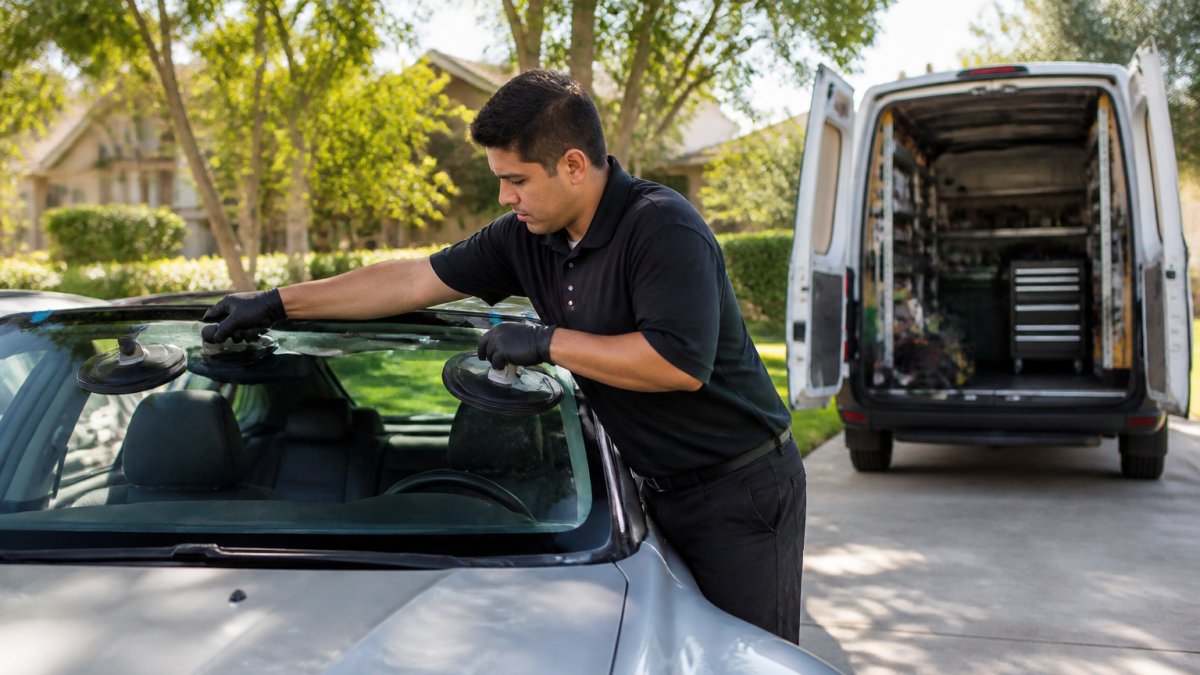
Most replacements finish in 30 to 90 minutes.
Comparing Your Windshield Replacement Service Options
The market splits into three paths, and each suits a different driver.
| Option | Best For | Watch Out For |
|---|---|---|
| Mobile full-service shop | Drivers who want it done at home or work | Confirm calibration is included |
| Quote marketplace | Comparing local pricing before booking | Quality varies by the shop you pick |
| National chain | Convenience and standardized process | Local availability varies by franchise |
| DIY chip kit | Tiny chips, tight budget | Not for cracks or ADAS-equipped cars |
For fleet managers running dozens of vehicles, the deciding factor is usually scheduling and paperwork, not the glass itself. A provider who handles direct billing with insurance and can service multiple vehicles on site saves more time than a cheaper per-unit quote.
This is where Area Wide Auto Glass fits. We come to your location, handle the insurance paperwork, and calibrate on site.
Certifications and Warranties That Separate Shops
Technician certification is the clearest quality signal you can check before you book, but the acronyms only help if you know what each one actually covers.
- AGSC (Auto Glass Safety Council), a registered training and certification program built around the ANSI/AGSC auto glass replacement safety standard. A shop that is an AGSC Registered Member has agreed to follow that standard, which covers urethane selection, surface prep, and safe drive-away time. This is the certification most directly tied to whether your windshield stays bonded in a crash.
- NGA (National Glass Association), the trade association behind the MyGlassClass training and the Auto Glass Safety Council’s parent structure. NGA credentials signal a shop that invests in ongoing technician education.
- I-CAR, collision repair training that includes auto glass and ADAS calibration courses. An I-CAR-trained technician has been tested on the same procedures the automakers publish, which matters most on ADAS-equipped vehicles.
Ask specifically whether the technician working on your car holds an ADAS calibration credential, not just a general glass certification. Calibration is a separate skill from glass installation, and a shop can be excellent at one and untrained in the other.
What a Warranty Should Actually Cover
Warranty language is where shops differ most, and where a low quote often hides its real cost. A warranty worth having covers three things:
- Workmanship, leaks, wind noise, and water intrusion caused by the installation itself.
- Materials, defects in the glass, urethane, or molding that show up after the install.
- Calibration, camera or sensor faults that appear after the replacement, when the shop performed the calibration.
A “lifetime warranty” that covers only materials but not labor means you still pay the labor to fix a leak. Ask which parts are covered and for how long, and get it on the invoice.
If a shop will not put the calibration warranty in writing, treat that as a signal. Calibration faults often surface weeks later, and without paperwork the correction is billed as a new job.
The Questions That Separate Shops
- Are your technicians AGSC registered, and who holds the ADAS calibration credential?
- Does the warranty cover workmanship, materials, and calibration, and for how long?
- Will you confirm in writing that calibration was performed, and to which OEM procedure?
- Do you use OEM, OES, or aftermarket glass, and which one is going on my car?
The lowest quote usually is not the cheapest outcome. Glass, urethane, and calibration are not places to cut corners, because a bad bond or a misaligned camera is a safety problem, not a cosmetic one. A certified technician, a written calibration record, and a warranty that covers all three categories are what you are actually paying for.
Conclusion
Windshield damage rarely waits for a convenient moment, and the repair-or-replace call gets harder every model year as more safety tech sits behind the glass. Get the assessment right, confirm your coverage, and make sure calibration is part of the job. Area Wide Auto Glass brings certified technicians, OEM-quality materials, ADAS calibration, and direct insurance billing to your home or workplace, backed by a lifetime warranty on materials and labor. Book an appointment and get your vehicle back on the road safely.
Frequently Asked Questions
How much should it cost to replace my windshield?
Windshield replacement cost depends on your vehicle’s make and model, whether the glass is OEM or aftermarket, and whether ADAS windshield calibration is required. Sensor-equipped windshields cost more because the camera and radar systems behind the glass need recalibration after installation. Area Wide Auto Glass does not publish flat rates, so request an online quote with your VIN and they will confirm the exact figure, including whether calibration is bundled in.
Will insurance cover a cracked windshield?
Most comprehensive coverage policies cover windshield replacement, often with a deductible that applies. Some policies waive the deductible for repair rather than full replacement. Area Wide Auto Glass bills major insurance companies directly, which reduces your out-of-pocket cost and paperwork. Call your insurer first to confirm your comprehensive coverage terms, then let the glass shop handle the claim from there.
Do I need to recalibrate my sensors after a windshield replacement?
Yes, if your vehicle has lane departure warning, adaptive cruise control, automatic emergency braking, or a forward-facing camera mounted behind the glass. ADAS windshield calibration restores the camera’s aim after the new windshield goes in. Skipping it can leave safety systems misreading the road. Ask any shop whether calibration is included in their quote, because some providers charge it as a separate line item.
How long does a mobile windshield replacement take?
Most replacements take 30 to 90 minutes of hands-on work. Add curing time for the windshield sealant before you can drive safely, which typically runs about an hour depending on temperature and humidity. Your technician will give you a safe drive-away time when the job wraps. Mobile service saves you the trip to a shop, since the work happens at your home or workplace.
Is OEM glass worth it over an aftermarket windshield?
OEM glass is manufactured to the vehicle maker’s original specifications and fits sensor brackets and trim exactly as designed. Aftermarket glass can cost less and often meets safety standards, but fit and optical clarity vary by manufacturer. On vehicles with ADAS cameras, OEM glass reduces the risk of calibration problems. Ask which option the shop installs by default and whether OEM is available for your model.

